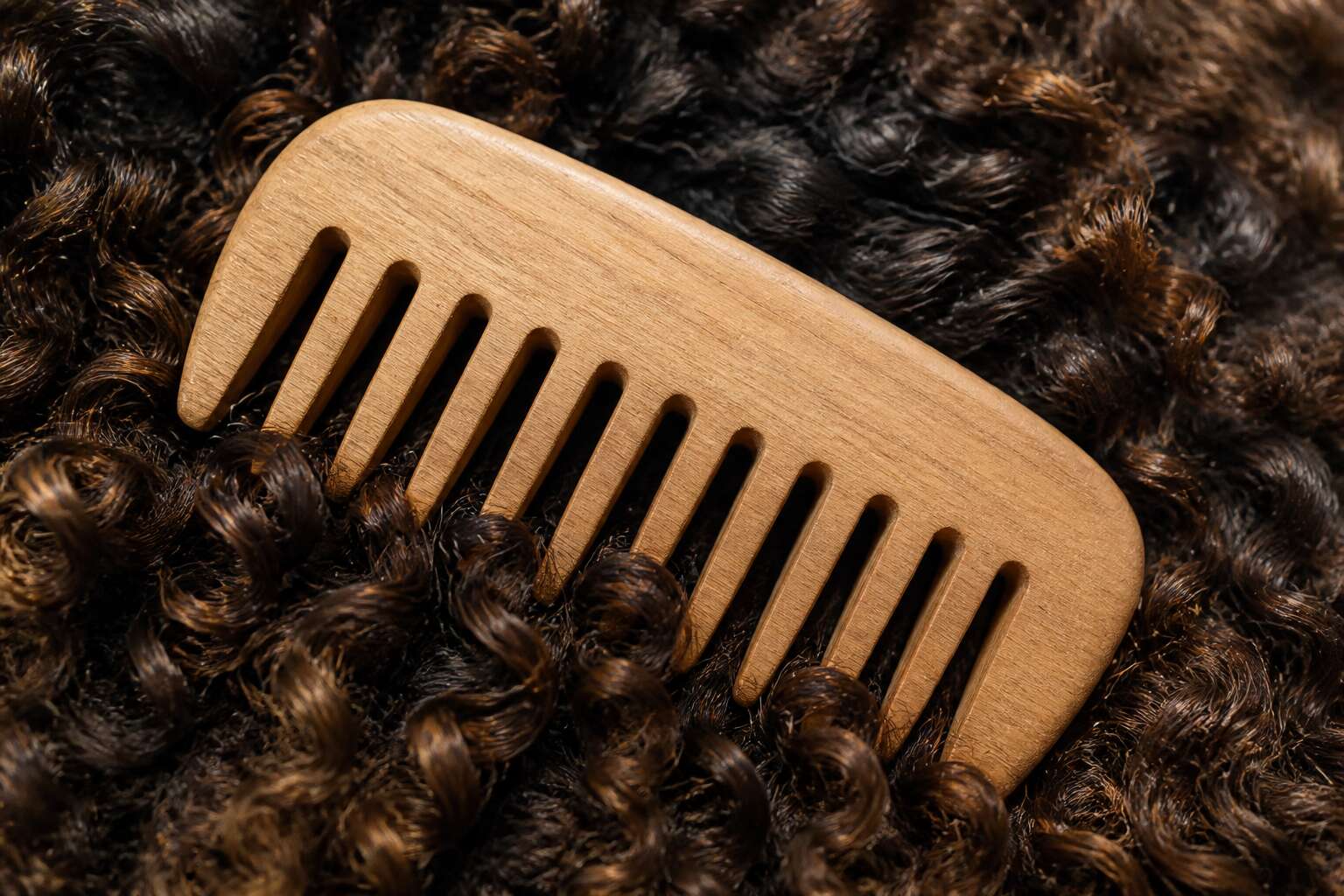
Why Comb Choice Matters for Curly Hair
The Science Behind Curly Hair Structure
Curly hair is structurally different. Each strand is not round but flattened and sometimes twisted, making it prone to snapping at weak points. This is why hair combs for curly hair cannot be an afterthought. A wrong comb pulls, tears, and creates frizz.
The science is clear. The cuticle layers of curly hair are raised and irregular. When you force a fine-toothed comb through, you strip moisture and damage the cortex. The result is dull, broken curls.
Here is what matters:
- Comb spacing affects tension.
- Material changes friction.
- Seamless teeth protect the cuticle.
These factors define how a comb interacts with each curve. Comb geometry alters the stress placed on fragile strands.
How the Wrong Comb Causes Frizz and Breakage
Frizz is not a mystery. It is mechanical damage made visible. When a comb with tight spacing meets a curl, it does not glide. It drags. Each snag pulls the strand beyond its elastic limit, and the cortex gives way. That is breakage.
Rough seams are equally destructive. They catch on every twist of the cuticle and drag the strand until it fractures. Within weeks you see short, broken hairs around the hairline. I have watched this pattern repeat across all curl types.
- Wide spacing in hair combs for curly hair allows curls to move without tension.
- Seamless teeth reduce friction at every contact point.
- Flexible material bends with the strand instead of against it.
Selecting the right hair combs for curly hair is not a matter of preference. The right tool distributes force evenly along the curve. The wrong one guarantees frizz before you begin styling.
Material Matters: Wood, Plastic, and Metal Compared
Wood combs draw natural oils along the strand, yet they warp in humid air. Plastic offers uniform teeth, but static builds in dry winters. Metal conducts temperature, which feels bracing on a cold Johannesburg morning. None are universally superior.
Consider the porosity of your curl. A wooden comb’s grain can snag on high-porosity hair. A polished plastic comb glides with less resistance. Metal, though slick, transmits every tug directly to the follicle. I have watched women in Durban swear by wide-tooth wooden styles. Their hair combs for curly hair rarely leave the bathroom drawer, though. Humidity swells the wood, and seams appear overnight.
- Wood: responsive, moisture-sensitive, traditional.
- Plastic: consistent, static-prone, affordable.
- Metal: cooling, durable, unforgiving on tangles.
Matching material to your local climate matters more than trend. That single decision changes how your hair combs for curly hair behave every morning.
Wide-Tooth vs. Fine-Tooth: Understanding the Difference
Wide-tooth combs create space between curls. Each coil travels through its own channel, preserving the natural grouping of strands. Fine-tooth combs eliminate that space. They press curls into closer quarters, forcing friction along every length.
Your texture determines which tool serves you. Fine-tooth combs suit straight or loosely waved hair. For dense, coily growth, the narrow teeth function as a barrier rather than an instrument.
- Wide-tooth: preserves curl formation during wet styling
- Fine-tooth: enables precise root-to-tip smoothing
Most Capetonians I meet keep both on hand! Their hair combs for curly hair shift with the season, humidity altering how much give the teeth offer. Spacing between teeth matters more than any other design feature.
The Role of Comb Spacing in Defining Curl Patterns
Nearly 70% of Capetonians with textured hair own more than one comb, yet most reach for whichever sits closest. That choice determines the final shape of every curl, and it explains why hair combs for curly hair demand more consideration than a five-second grab.
Comb spacing dictates how many strands travel together. The ideal gap tracks your curl’s diameter:
- 6 to 7 millimetres suits loose spirals
- 8 to 10 millimetres accommodates tight coils
Anything narrower presses strands into unwanted contact, which flattens the pattern.
Local humidity complicates this further. A comb that parts your hair easily in summer may snag in winter when moisture alters the coil’s width. The gap must follow your pattern, not the other way around.
Types of Combs Best Suited for Curly Hair
Wide-Tooth Combs: The Curly Hair Essential
The wide-tooth comb has a reputation for being boring, and that is exactly why it works. While fine-tooth combs pull strands, this model allows for gentle detangling. In South Africa, where humidity changes often, this comb is necessary.
A good wide-tooth comb does not need extra features. It needs:
- Smooth, rounded teeth that do not scratch the scalp
- Wide gaps that let coils breathe
- A sturdy grip for wet hair handling
Hair combs for curly hair should be practical, not painful. The wide-tooth version delivers that. It works with hair’s natural pattern when detangling in the shower. Many combs fail because they are too aggressive, but wide-tooth combs yield at the right moment.
Detangling Combs: Working Through Knots Safely
Knots form from friction and moisture. Detangling combs handle that damage without force. I have found that these combs, with their flexible teeth, do the work most tools cannot. A rigid comb snaps through a tangle. A detangling comb bends and releases it from the edges inward.
What separates a useful detangling comb from a failure? Look for these traits before buying!
- Teeth that flex without staying bent
- Rounded tips that slide over knots
- A handle with grip for wet fingers
For hair combs for curly hair, the detangling model works best when you start at the ends and move upward. In Cape Town’s humid summers, tangles cling harder. This comb reduces pulling force, which keeps the cuticle intact and the curl pattern defined.
Custom Wooden Combs: Why Craftsmanship Counts
Custom wooden combs are quieter instruments. A machine stamped comb leaves microscopic burrs along the teeth, and those burrs catch on the delicate edges of each curl. A craftsman sands every tooth by hand, creating a surface that slips through hair without resistance.
Among hair combs for curly hair, the wood itself matters. Dense hardwoods resist moisture and hold their shape over time. The teeth taper to rounded points that glide rather than pull. The handle sits in the palm with a weight that feels deliberate.
What separates a well made custom comb from the rest?
- Hand sanded teeth with no rough transitions
- A seamless joint between handle and tooth
- Oiled wood that repels water and humidity
Cape Town’s coastal air changes how any comb behaves. A rushed design warps and loses its smooth motion. A custom wooden comb keeps its integrity for years, which matters when you have invested in your curl pattern.
Pocket-Sized Combs for On-the-Go Touch-Ups
Every curl has a breaking point. Mine arrived at three in the afternoon, when humidity crept in from the Atlantic and my pattern collapsed into a dull mess. Then I started carrying a pocket comb.
Pocket sized hair combs for curly hair are not for full detangling sessions. They are for quick, surgical touch ups. You find the curl that wandered off, you lift it, you let it settle. The comb is small because the work is small.
A good pocket comb has these qualities:
- Teeth wide enough to pass through a dry curl without catching
- No sharp edges anywhere along the body
- A shape that fits the palm or slips into a jeans pocket
The compact comb does not replace your main comb. It simply holds the pattern between washes, and that is everything when you are hours from home!
Flexible and Seamless Combs for Gentle Styling
Flexible combs bend rather than fight the curve of your scalp. Rigid combs press hard against the skull; flexible ones follow the terrain. This makes them practical for styling near the crown, where our skulls curve sharply and stiff tools bounce off at awkward angles.
Seamless combs deserve equal attention. A seam is a joint where plastic was molded in two halves, and those joins catch stray strands. Look for single-piece construction. The best examples have no ridge, no weld, no interruption. For curly hair, a smooth surface is not a luxury, it is a requirement.
- Flexible teeth absorb tension before it reaches the root
- Seamless bodies prevent snagging at the midpoint of the strand
- Both features reduce the urge to yank
These combs do not detangle. They coax. For hair combs for curly hair, that distinction is everything.
Avoiding Combs with Seams and Sharp Edges
A comb with a sharp edge can easily find your weakest strand. For people with curly hair, that edge cuts the protective cuticle. The best combs for this hair type have teeth that taper to rounded tips, not angular points. Flat edges catch on every bend in the curl.
Seams and sharp edges appear on mass produced plastic combs. The molding process leaves a ridge that feels smooth to the finger but tears under magnification. Avoid combs with visible parting lines. Instead, choose tools with polished, beveled teeth. These reduce friction where the strand enters the gap.
- Wide spaced teeth prevent curl compression
- Rounded edges let hair slide without snagging
- Smooth spines reduce scalp friction
Sharp edges also damage the scalp. A comb that scrapes the skin causes micro tears. For hair combs for curly hair, seek designs where every surface is smooth. Your curls will hold their shape without punishment.
Step-by-Step Combing Techniques for Curly Hair
Combing Wet vs. Dry: What the Experts Recommend
Roughly 65% of curl breakage occurs during the combing window, not the styling phase. Timing dictates everything.
For wet hair, experts follow a strict sequence:
- Apply slip-heavy conditioner while strands remain saturated
- Begin at the tips, never the root, to avoid forcing knots upward
- Move through each section slowly, holding the curl base for support
Dry combing demands restraint. Hair combs for curly hair used on dry curls should serve only to nudge a flattened silhouette back to life. Detangling on dry hair forces the cuticle to catch and lift, which produces immediate fraying. The comb should glide, never drag. When it meets resistance, stop and return to wet styling rather than pushing through.
Sectioning Your Hair for Effective Detangling
Split your curls into quadrants before combing and you have already won half the battle. Sectioning is the discipline that prevents frantic tugging and snapped strands. First, part your hair down the centre, then divide it horizontally at ear level, yielding four manageable zones. Secure each with a snag-free clip, leaving one quadrant free to work.
Begin with the bottom layer, since it hides the most stubborn knots. Lightly mist the section and pick from your arsenal of hair combs for curly hair. Starting at the tips, glide the comb upward while cradling the curl root with your other hand. Move through each section slowly, always respecting the direction of the curl. This method turns a tangled terror into a quiet, orderly ritual.
The Proper Way to Hold and Glide a Comb
Some say the comb is an extension of the hand, and for those with textured hair, this is not poetry but physics. The proper hold is gentle yet decisive. Grip the spine of your hair combs for curly hair between your thumb and forefinger, letting the remaining fingers rest against the base for stability. You are not gripping a tool. You are guiding a mechanism.
The glide begins at the wrist. A rigid, elbow driven stroke will catch on every curve and kink. Instead, allow your wrist to rotate slightly as the comb travels, following the natural arc of the strand. The motion is a series of small, deliberate advances rather than one long pull. Think of it as coaxing the fibers into alignment, not dragging them into submission.
– Start with the comb parallel to the scalp, teeth pointing outward.
– Use your opposite hand to hold the section taut at the root.
– Move the comb from tip to root in a slow, smooth motion.
This coordination between both hands is the ultimate technique. The stabilizing hand provides the tension needed to prevent the scalp from pulling, while the combing hand does the work. As you reach the root, ease the pressure. The hair should leave the comb naturally, without resistance. It is a rhythm, a quiet conversation between your hands and the curls, and it makes all the difference in preserving your pattern.
Combing in the Shower: Best Practices with Conditioner
Conditioner changes how hair responds to tension. Water alone leaves the cuticle rough, but a generous layer of slip allows the teeth to glide without grabbing. In the shower, your hair combs for curly hair should never touch dry strands. Work in sections, starting from the bottom.
- Apply conditioner and let it saturate the hair for a full minute.
- Angle the comb downward through the ends, then gradually work higher.
- Flush the comb under the water after every stroke to remove shed strands.
- Add a small amount of conditioner to the ends before moving to the next section.
The water keeps the hair elastic, and the conditioner reduces friction. This combination lets you address knots without forcing them. Let the weight of the comb do the work. Your hair combs for curly hair should feel light in your hand, and the motion should stay effortless.
Common Combing Mistakes That Damage Curls
A comb should never feel like a weapon. Yet many curly haired individuals attack their strands with brute force, causing breakage. I have watched this happen too often. The correct technique begins with patience. Starting at the lowest tangle, let the teeth catch only a few strands at a time. Use hair combs for curly hair that offer wide spacing and smooth seams.
Common mistakes include yanking through a knot, which stretches the hair past its limit. Another error is using a fine-tooth comb on dry curls. That tears the cuticle. Also, moving too fast from root to tip compresses tangles into a denser mess.
But with deliberate, slow strokes, the comb glides through. Your curls remain intact. That is the entire secret!
How to Comb Curly Hair Without Losing Definition
The difference between defined curls and frizz often comes down to where your comb starts, not how many strokes you take. Begin with soaked, conditioned hair. Dry strands resist movement and tear easily. Hold the comb near the end of the handle. A loose wrist gives you control without pressing into the scalp.
Work from the bottom upward. Slide the teeth through the last few centimetres of hair first. Once that section glides freely, move higher. Repeat until the whole strand is smooth. For most curl patterns, one pass is enough.
Follow these steps for a consistent routine:
- Apply a slippery conditioner and spread it evenly.
- Use hair combs for curly hair that have wide spacing and no seams.
- Let the comb rest on the ends, then glide upward slowly.
Finish by scrunching the hair upward to restore the curl clumps. Leave the comb alone until the hair dries fully.
Maintaining and Cleaning Your Hair Combs
How Often to Clean Your Comb for Best Results
A comb used daily on curly hair collects oils, product residue, and dust. The scalp sheds thousands of dead skin cells each week, and these accumulate between the teeth. For hair combs for curly hair, cleaning every two weeks prevents this buildup from transferring back onto freshly washed curls. A simple soak in warm water with a drop of mild shampoo works well.
Some combs need more frequent attention. If you use heavy butters or gels, clean weekly. If you only detangle on wash day, a monthly rinse may suffice. You will know it is time when the comb shows these signs:
- Visible residue sitting between the teeth
- A greasy feel even after rinsing
- Strands that cling to the comb after use
- A musty or sour smell
Simple Cleaning Solutions Using Household Items
Your comb collects every product you have ever used and plenty of what your scalp sheds. In my experience, nothing restores grubby hair combs for curly hair like white vinegar and baking soda from your kitchen. Mix one part vinegar with three parts warm water and soak the comb for twenty minutes. The solution dissolves product residue without harming the comb’s surface.
For a deeper clean, baking soda becomes a mild abrasive paste. Work it between the teeth with an old toothbrush, then rinse thoroughly. Wooden combs must be dried immediately and rubbed with a drop of jojoba oil to prevent cracking.
The essentials:
- White vinegar dissolves mineral buildup from hard water
- Baking soda neutralises odours and lifts stubborn residue
- An old toothbrush reaches the crevices between teeth
Hair combs for curly hair may be wide-toothed, but they still need this simple upkeep to slide through your curls without snagging.
Drying and Sanitizing: Keeping Bacteria at Bay
A comb left damp overnight becomes a breeding ground. The drying phase matters more than most people admit. Bathroom counters stay warm and humid for hours, so pat the comb dry with a lint-free cloth and rest it on a breathable towel rack instead of a closed drawer.
Moisture trapped in hair combs for curly hair gives microbes a place to multiply. A weekly sanitizing routine fixes this. Plastic and resin combs handle a wipe with isopropyl alcohol on a cotton pad. Wooden combs never touch alcohol, since it strips their protective oils.
Sanitizing is overdue if:
- A musty scent lingers after rinsing
- Residue feels slippery to the touch
- A white film sits at the base of the teeth
When drying hair combs for curly hair, stand them on a clean edge. Let them air out completely before storing them in a case, otherwise bacteria return.
Signs Your Comb Needs Replacing
There comes a moment in every comb’s life when it stops being a tool and starts being a liability. The average family keeps the same one for years, not because it works, but because nobody thinks to audit it. A worn comb causes subtle damage to curl patterns.
Maintenance starts with honest inspection. After each wash, run a fingernail along the teeth. If you feel a burr or a rough patch, that tooth will snag your hair next time. For hair combs for curly hair, friction leads to snags and frayed ends. A plastic comb can develop microscopic cracks invisible to the eye, so trust your senses. I have learned this the expensive way. A weekly finger test costs nothing.
Signs your comb needs replacing include:
- Bent or missing teeth that pull instead of separate
- Discoloration or a chalky texture that no rinse removes
- A hairline crack along the spine that could split mid-stroke
When these appear, the comb has outlived its usefulness. Hair combs for curly hair are tools, not keepsakes. A fresh one restores order, and your strands will feel the difference immediately.
Proper Storage to Extend Comb Lifespan
Proper storage determines how long a comb remains useful. A well maintained comb performs better after years of use. Stray strands and moisture cause damage; wiping the teeth dry after each wash and allowing the comb to air dry completely prevents warping in plastic bases and softening in wooden handles.
Flat storage in a lined drawer or a dedicated case protects the teeth from bending. Heat and direct sunlight degrade comb materials over time, so keeping them away from radiators and bathroom mirrors extends their lifespan. This routine preserves the smooth glide that hair combs for curly hair depend on, preventing the tiny snags that disturb curl patterns.
Matching Combs to Your Specific Curl Pattern
Loose Waves and Soft Curls: Best Comb Options
One stylist in Johannesburg told me that loose waves lose their shape when a comb drags. So the solution is a tool that matches their delicate structure. For soft curls, a comb with widely spaced teeth and a seamless finish preserves the natural bend without pulling the wave apart.
Look for these features:
- Wide gaps that let hair move freely
- Rounded tips to prevent scalp irritation
- A flexible body that follows the head’s contour
I have found that hair combs for curly hair work best when they are shorter and lighter for this pattern, allowing precise control. The comb should glide smoothly and stay stable in the hand.
Tight Coils: Choosing a Comb That Respects Your Texture
Tight coils are a study in contradiction: they appear robust, yet they break with startling ease. The hair combs for curly hair that work best for this pattern negotiate gently instead of forcing compliance. I have found that a comb with rounded, widely spaced teeth allows each coil to maintain its own shape.
- Teeth that are smooth to the touch and free of any seam
- A length that feels balanced in the palm, not unwieldy
- Spacing wide enough to hold several coils without compression
The comb should move through damp, conditioned hair in short strokes. When it meets resistance, stop. Tight coils ask for patience, not pressure.
Kinky Hair: Special Considerations for Combing
Kinky hair is the most misunderstood texture in the curly spectrum. It looks resilient, but it breaks under the slightest pressure. The right hair combs for curly hair work with this paradox, not against it. My own journey with kinky hair involved a lot of snapped strands before I figured this out!
- Long teeth that can reach the root without scraping the scalp
- Smooth, seam free edges that do not catch on individual strands
- A handle that fits your grip even when coated in conditioner
Combing in the shower while your hair is soaked in conditioner allows the teeth to glide through each section. Starting at the ends and working upward prevents unnecessary strain. If the comb meets resistance, stopping is the only safe response. Push once, and you will spend an hour untangling the aftermath. Kinky hair rewards slow, deliberate movements.
Children’s Curly Hair: Safe Combing Practices
A child’s tears are the clearest signal that a comb is wrong for their curls. The scalp is more sensitive and the curl pattern still developing. I have seen parents reach for adult combs and wonder why their child cries. The answer lies in matching the comb to the exact curl shape. Loose waves need wider spacing, while tight coils require shorter, smoother teeth. Children with mixed patterns benefit from a comb that flexes at the base. hair combs for curly hair should also have rounded tips to protect the delicate hairline. Many caregivers overlook the importance of a child’s grip. Let the child hold the comb. This builds trust and reduces fear!
- Use a separate comb for each child to prevent scalp irritation.
- Comb in small sections with a leave in conditioner.
The goal with hair combs for curly hair is gentle progress. A relaxed child means fewer tears.
Transitioning Hair: Comb Tips for Natural Hair Growth
Transitioning hair presents a unique problem: the old texture and the new texture coexist on the same strand. The point where they meet is brittle, and a careless stroke can snap months of progress. Hair combs for curly hair must therefore be chosen with the transition zone in mind. Wide teeth and a flexible body ride over the boundary instead of catching it. I have seen clients lose length when a fine tooth comb wedged at the demarcation line and tore the weakest part. Starting near the ends and moving upward spares that junction.
The comb also needs to work with the emerging pattern. Stiff bristles or sharp seams leave micro tears that slow natural hair growth. A wooden comb with rounded tips distributes pressure evenly across both textures. For the first year, one comb rarely fits every section. The crown, nape, and hairline respond differently. Hair combs for curly hair must meet each zone on its own terms, allowing new growth to lengthen without being forced.




0 Comments