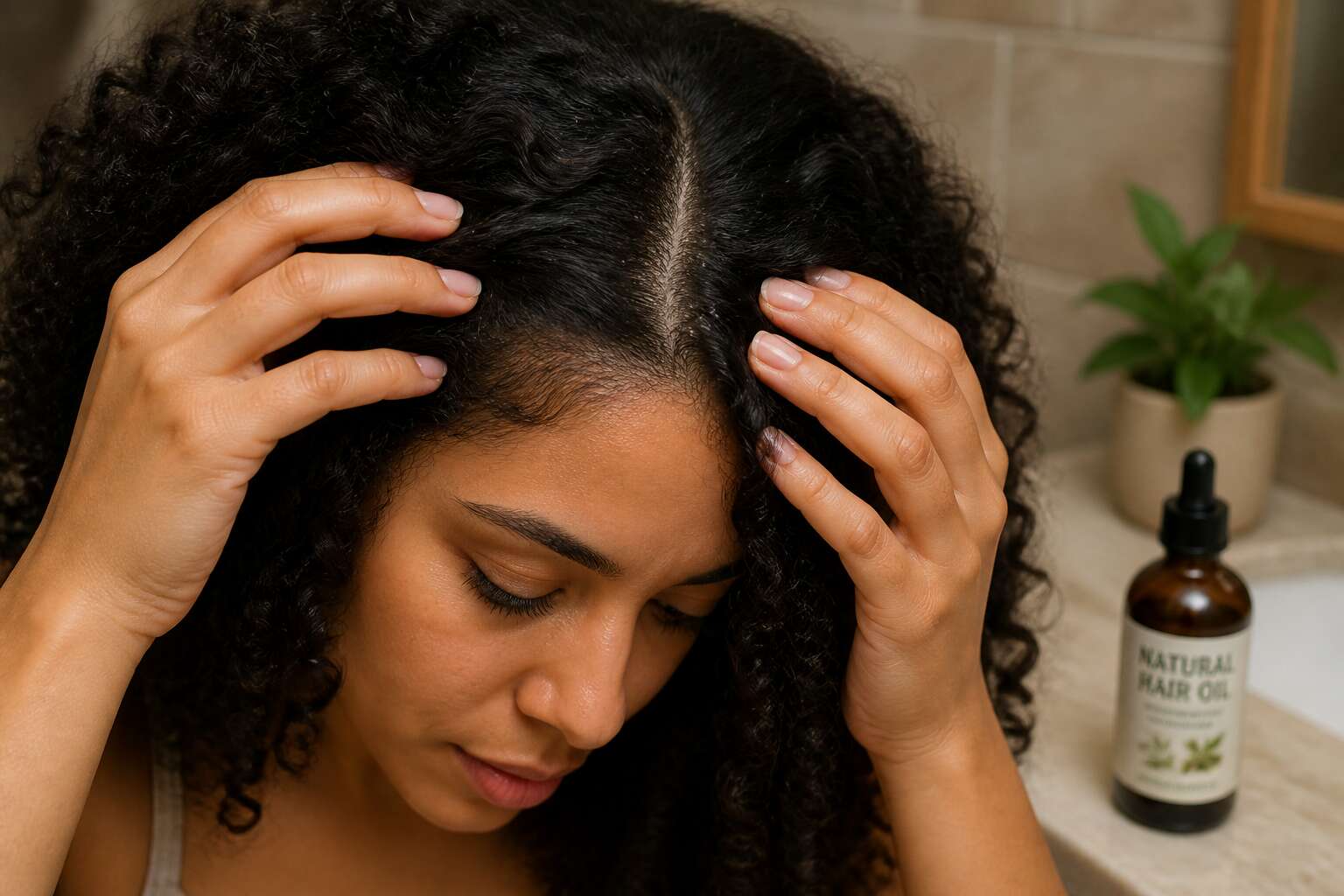
Why Curly Hair Is More Prone to Dandruff
The Unique Structure of Curly Hair and Scalp Interaction
The geometry of curly hair creates a set of problems that straight hair rarely encounters. Sebum, the scalp’s natural oil, moves efficiently along straight shafts. In curls, the twists and turns disrupt that flow. The scalp receives less lubrication, leading to dryness, flaking, and irritation. This is how the curly hair and dandruff connection begins.
Follicle curvature adds to the problem. Curved follicles shed dead skin cells at an uneven rate, and those cells can accumulate in the folds of the curl. The result is a scalp environment where moisture gets trapped, and the yeast Malassezia thrives. For anyone managing curly hair and dandruff, the challenges start at the follicle itself.
- Slower sebum migration due to bends in the hair shaft
- Dead skin cell build-up along the follicle curve
- Trapped moisture in dense, coiled patterns
How Curly Hair Traps Oil, Sweat, and Product Buildup
Scalp conditions are often misunderstood, and the link between curly hair and dandruff is a prime example. Research suggests that over 60% of people with textured hair report experiencing flaking at some point, a figure that outpaces those with straight locks.
The culprit isn’t simply a dry scalp; rather, it is the geometry of the curl itself. The natural path of hair growth creates a physical barrier. When sebum is produced at the follicle, it must travel upward. On a straight strand, this journey is a straight line. On a curly strand, the oil hits a bend, then another, stagnating before it ever reaches the hair end. This leaves the scalp under-moisturized, prompting it to overproduce oils in a panic, which then mix with dead skin cells to form visible flakes.
Beyond the oil, curly hair is a magnet for environmental soot and microbial debris. The dense, interlocking pattern of the coils acts like a net, capturing particles that would normally fall away. Sweat during a warm Johannesburg afternoon evaporates slowly in these dense curls. This trapped moisture lowers the scalp’s natural acidity.
Product buildup is the final layer. Creams, butters, and gels designed to define curls often contain heavy oils and waxes. These ingredients are necessary for hold, but they are notoriously difficult to wash out completely.
– Shampoos with harsh sulfates strip the scalp, causing rebound oiliness.
– Conditioners and leave-ins sit on the follicle opening, clogging it.
– Hard water minerals bind to the hair fiber, creating a film that suffocates the skin.
This accumulation creates a Petri dish effect. The trapped oil, sweat, and product provide a banquet for the Malassezia fungus, turning a routine dry scalp into a persistent inflammatory response. Managing curly hair and dandruff requires understanding that you are fighting the structure of the hair itself.
Common Misconceptions About Curly Hair and Flakes
Flaking on curly hair is routinely misdiagnosed, even by those who live with it daily. I hear the same assumption repeatedly: flakes signal a dry scalp. So people reach for heavy oils, and the problem worsens! Curly hair and dandruff rarely stem from dryness alone. Sebum production often remains normal. The difference lies in the scalp’s ecosystem and how it responds to the physical environment around each follicle, which differs for textured hair.
Several misconceptions circulate:
- Flakes equal poor cleansing. This belief drives excessive scrubbing, which inflames the scalp and worsens curly hair and dandruff symptoms.
- All anti-dandruff shampoos work for textured hair. Many contain sulfates that leave curls brittle and the scalp stripped of its protective barrier.
A third error involves seasonal assumptions. South Africans often blame winter dryness for flaking. Warmer months bring humidity and sweat, yet flakes persist, pointing to a microbial factor instead.
The Role of Sebum and Moisture Imbalance
Sebum production remains steady on most scalps, including those with curly hair. Yet the spiral path of each strand prevents that oil from traveling evenly from root to tip. Instead, sebum pools near the follicle while ends stay parched.
This moisture imbalance weakens the scalp’s protective film and invites irritation. When the flora shifts, curly hair and dandruff often appear together. The cause is the microbial environment, not simple dryness. In South Africa’s humid coastal regions, sweat compounds the issue. On the highveld, sun exposure adds stress. Either way, the result is compromised sebum flow.
I have seen clients repeatedly oil their scalps, thinking they need moisture. The opposite is true! Treating the scalp’s ecosystem matters far more than adding more oil.
Identifying the Root Causes of Flaking on Curly Hair
Seborrheic Dermatitis vs. Simple Dryness
Flaking that plagues curly hair and dandruff often traces back to two separate conditions. Seborrheic dermatitis leaves yellowish, greasy scales with redness beneath, while simple dryness produces fine, white, powdery debris. A finger test reveals the difference: rub the scalp gently. Oily residue suggests seborrheic dermatitis; a tight, rough sensation indicates moisture loss.
Curly hair obscures this diagnosis because its spirals hide the skin. Part the curls in several sections and inspect the base. Look for inflammation or silvery patches. Your location matters too. Cape Town’s coastal humidity creates different symptoms than Johannesburg’s dry Highveld air. A treatment that works in Durban may fail in Pretoria, since these causes oppose each other. Understanding this root distinction prevents wasted effort and further irritation.
Fungal Overgrowth and Malassezia in Curly Hair
Most flakes on curly hair trace back to Malassezia, a yeast that colonizes every human scalp. In tight spirals, this fungus finds abundant fuel. Sebum becomes food, sweat adds moisture, and product buildup traps both beneath the cuticle. The overgrowth irritates the skin and accelerates cell turnover, producing visible flakes.
Three conditions allow Malassezia to flourish:
- Heavy leave-in butters left on the roots
- Infrequent washing triggered by fear of dryness
- High humidity, as seen in coastal cities like Durban
Each factor alters the scalp’s microclimate. Treating curly hair and dandruff means confronting this fungal presence directly. A cleanser with pyrithione zinc or ketoconazole can suppress the yeast, but only after you accept that the problem lives in the microbiome, not in the curl pattern itself.
Contact Dermatitis from Styling Products
The irony of the curly hair journey is that we heap products onto our scalps in the name of hydration, yet these very offerings often betray us. Contact dermatitis from styling products is a frequent, yet unspoken, culprit behind persistent flaking. Much like an uninvited guest at a braai, your leave-in conditioner can overstay its welcome, causing the skin to react with redness, itching, and those dreaded white sheets. This reaction is not a failure of your hair care routine, but a chemical intolerance specific to your biology.
Fragrances and preservatives are the usual instigators of this inflammatory response. When the scalp’s barrier is compromised, it loses moisture and becomes hypersensitive. The flakes produced here are often drier and smaller than those caused by seborrheic dermatitis. Consider the products you apply directly to the roots:
– Heavy oils like coconut or shea butter, which can be comedogenic for some skin types
– Sulfates lurking in clarifying shampoos, which strip the scalp of its natural lipids
– Essential oils such as tea tree or peppermint, which are potent allergens for sensitive individuals
This scenario creates a paradox where the treatment for dryness becomes the agent of your discomfort. The irritation triggers an immune response, accelerating skin cell turnover. To distinguish this from a fungal issue, observe the texture of the flakes and the accompanying sensation. A burning or stinging feeling after application is a clear signal. In the South African climate, where humidity levels fluctuate dramatically, the interaction between sweat, product residue, and the skin’s chemistry intensifies. Managing curly hair and dandruff requires auditing your product labels with the same scrutiny you’d apply to a bank statement. Simplify your regimen to identify the offending agent, and allow your scalp’s microbiome to reset.
Low-Porosity Curls and Product Buildup
The scalp’s silence can be deceptive. For those with low porosity curls, the cuticle scales lie flat and tight, like a locked door. This structure resists water absorption, causing products to sit on the surface rather than penetrate. The result is a gradual accumulation of creams, butters, and oils that form an oleaginous film. This film becomes a trap for sweat and sebum, creating a dense layer that suffocates the follicle.
This buildup disrupts the natural shedding process. The trapped cells clump together, creating flakes that are often mistaken for dandruff. Here is what distinguishes this mechanical issue from a microbial one:
1. The flakes are often larger and waxy, not powdery.
2. The scalp feels congested and heavy, not necessarily itchy.
3. The hair becomes greasy at the root but brittle at the ends.
The paradox intensifies when you respond by washing more frequently. Harsh surfactants strip the minimal moisture from the hair shaft, prompting you to apply even more styling products. This cycle of over-moisturizing and over-cleansing exacerbates the very condition you are trying to solve. Managing curly hair and dandruff, in this case, requires breaking the cycle of accumulation before addressing any fungal element. The scalp cannot breathe under the weight of residue, and the resulting inflammation mimics the symptoms of a fungal infection.
Stress, Hormones, and Immune Response
When stress raises cortisol, the scalp’s immune response can mistakenly attack its own tissue. For people with curly hair and dandruff, this reaction shows up as inflammation and flaking unrelated to product residue. Hormones shift during pregnancy, thyroid imbalances, or sleep deprivation, altering sebum production and cell turnover. The result is uneven shedding that leaves clusters of immature skin cells on the scalp.
I have seen this pattern in clients reporting sudden flaking after a major life change. Consider these hidden triggers:
- A spike in androgens thickens sebum, which traps dead cells along the hair shaft.
- Chronic stress reduces antimicrobial peptides, allowing yeast to multiply unchecked.
The immune response misfires, causing redness and sensitivity. This is why a routine that worked for months suddenly fails. Stress alters the biological environment, not the product lineup.
The Best Cleansing Methods for Curly Hair With Dandruff
Choosing a Sulfate-Free Yet Effective Cleanser
Most curly-haired people wash less often to protect their coils, but that habit can backfire when flakes appear. For curly hair and dandruff, the trick is to cleanse enough to break down sebum and product residue without leaving the scalp parched.
A sulfate-free yet effective cleanser usually contains a mild surfactant, like cocamidopropyl betaine, paired with scalp-calming actives. I’ve seen good results with formulas that balance these ingredients:
- Salicylic acid to loosen dead skin
- Piroctone olamine to limit malassezia activity
- Aloe or glycerin to hold onto moisture
Apply the product directly to the scalp, work it in with your fingertips, and let the lather rinse over the lengths. This method clears buildup while preserving the hair’s natural oils.
Pre-Wash and Pre-Poo Techniques for Flaky Scalps
Pre-wash rituals often determine how your scalp responds to cleansing. A pre-poo treatment, done correctly, can dissolve the sticky combination of sebum, sweat, and product residue that contributes to curly hair and dandruff. I have found that applying a fatty acid rich oil, such as castor or marula, to the scalp for fifteen minutes softens the buildup without stripping moisture. Then, a gentle finger massage lifts flakes before they become trapped in dense coils.
For those with sensitive scalps, consider alternating these techniques:
Use a diluted apple cider vinegar rinse to adjust pH.
Apply a clay mask with kaolin to draw out impurities.
Steam the hair with warm towel to open cuticles.
Each method targets the scalp’s surface while protecting the curl pattern. The goal is to prepare the terrain, not to over-clean it. This pre-poo phase changes how later products interact, reducing the chance of rebound flaking.
Double Cleansing for Curly Hair Explained
Double cleansing is a two-stage method that works well for curly hair and dandruff. The first pass removes surface oils and loose debris. The second pass targets the scalp directly. Dense coils hold onto residue more stubbornly than straight hair.
A common mistake is treating every wash as a deep scrub. That approach disrupts the scalp’s moisture barrier. Instead, let the first cleanse remove the bulk of buildup. I recommend a gentle, sulphate-free shampoo. Then follow with a moisturising conditioner or a second cleanser with a different pH profile. For those managing curly hair and dandruff, the extra step is necessary adjustment.
For stubborn flakes, consider rotating two methods:
- Use a cleansing conditioner first to soften buildup.
- Finish with a low-foam shampoo on roots only.
This rhythm keeps the scalp balanced without stripping strands. Repeated weekly, it reduces recurrence of flakes while preserving curl definition.
Proper Scalp Massage and Finger Placement
Few routines unnerve a flaky scalp like the urge to scratch. That urge is a reaction, not a remedy. For curly hair and dandruff, the scalp’s terrain is uneven and the follicles are prone to breakage under pressure. Pressing hard with fingertips creates micro tears. Those tears become entry points for irritation. The relief is momentary. The consequence is a prolonged cycle of inflammation and shedding. Proper scalp massage changes this relationship entirely.
The goal is to lift flakes without forcing them off. Use the pads of your fingers, not the tips. The tips concentrate force into a small area, which dents the skin. The pads distribute pressure across a wider surface. Move in small, slow circles. Let the skin move with you, not against you. Spend about three minutes total, focusing on the hairline and the crown, where sweat and product tend to pool.
Correct finger placement also protects the cuticle. When fingers slide across strands, they disturb the curl pattern. When they stay rooted on the scalp, they work with the follicle’s natural direction. Here is the common error:
– Pushing fingers upward against the grain, which causes tangles.
– Scraping nails across the scalp, which leaves micro abrasions.
– Massaging with wet, soapy hands, which creates friction on the hair shaft.
Each error feeds the same problem. The flakes return because the scalp is stressed, not because it is unclean. A gentle, circular motion with steady pressure allows the warm water and cleanser to dissolve the sebum that anchors flakes to the skin. The rhythm matters more than the force. Slow and deliberate wins over fast and vigorous every time. For those managing both curly hair and dandruff, this step is not optional. It is the bridge between washing and healing.
How Often to Wash Curly Hair When Managing Dandruff
Cleansing curly hair and dandruff requires a balance that many routines miss. The scalp needs thorough washing, yet the strands cannot tolerate harsh stripping. For most people, washing once or twice a week works, but sweat, product use, and humidity in South Africa can shift that schedule.
Start with lukewarm water to loosen buildup. Apply a small amount of cleanser directly to the scalp, not the lengths. Work it in with the pads of your fingers, then let the suds travel down the hair as you rinse. This prevents the roots from becoming dry while still removing flakes.
- Shampoo the scalp twice if the flakes are thick.
- Rinse with cool water to seal the cuticle.
- Follow with a lightweight conditioner, avoiding the roots.
Overwashing curly hair and dandruff triggers more oil production. Underwashing lets flakes accumulate. Pay attention to how your scalp feels two days after washing; that is your signal to adjust the frequency.
Avoiding Over-Washing and Moisture Stripping
More than half of adults with textured hair report persistent scalp flaking, yet the reflex to scrub harder with aggressive cleansers often backfires. The challenge with curly hair and dandruff lies in the fact that a flaky scalp demands dissolution of biofilm, while the delicate curl pattern requires preservation of its natural lipid barrier. Aggressive surfactants may remove yeast and debris, but they also fracture the cuticle, leaving the hair brittle and the scalp prone to a rebound effect of excessive sebum production.
The most effective approach uses a two-phase strategy that separates scalp treatment from hair hydration. Before any water touches the strands, apply a pre-cleansing oil with a natural antifungal property, such as neem or tea tree diluted in jojoba, directly to the scalp. Leave it for ten minutes to soften the adherent scale, then emulsify with water. This step breaks down the hydrophobic barrier of sebum that traps Malassezia, making the subsequent wash more effective without requiring harsh detergents. The cleansing itself should be performed with the head tilted forward, allowing gravity to keep the suds off the fragile ends. A silicone scrubber, not fingertips, lifts flakes from the follicle opening, enhancing the efficacy of the medicated shampoo while stimulating circulation to prevent the stagnation that worsens flaking. Following this method, the hair requires no additional conditioning at the roots, only a light application to the mid-lengths, ensuring the scalp remains clean and the curls retain their natural bounce.
Targeted Ingredients and Treatments for Curly Scalp Dandruff
Pyrithione Zinc and Its Effects on Curly Hair
The scalp whispers its grievances in flakes. Pyrithione zinc answers with a metallic precision, disrupting the fungal cells that thrive beneath curls. This compound binds to keratin, which means it lingers on the hair shaft longer than on straight strands. That persistence is useful, but it also amplifies the drying effect.
For those managing curly hair and dandruff, the tradeoff demands vigilance. Curls already struggle to retain moisture; zinc strips away the oil that keeps them supple. The result can be a brittle halo around a quieter scalp. Some formulations combine zinc with moisturisers, yet the balance remains delicate.
Consider what this ingredient demands of your routine:
– Follow with a deep conditioner to restore hydration.
– Limit use to twice weekly, avoiding the lengths.
– Pair with a gentle cleanser to prevent irritation.
The effectiveness is real. The cost is a negotiation with your own texture.
Salicylic Acid for Scalp Exfoliation and Flake Removal
Salicylic acid works differently. It does not attack fungus. It dissolves the glue that holds dead skin cells together. For curly hair and dandruff, this matters because flakes often cling to the hair shaft. The acid softens them, allowing water to wash them away without harsh scrubbing.
This ingredient is a beta hydroxy acid. It penetrates the oil trapped around the follicle. It does not strip the scalp entirely, which is rare among anti-dandruff actives. Curly hair and dandruff respond well when the skin barrier stays intact.
Use it as a targeted treatment. Apply it directly to the scalp, not the strands. Leave it for five minutes before cleansing. This method lifts buildup effectively. Too much application causes irritation. Once weekly is sufficient for most curly textures.
– Let the product sit, making sure it reaches the skin.
– Use your fingertips to gently lift softened flakes in small circles.
– Rinse with lukewarm water to prevent additional dryness.
Salicylic acid suits those whose flakes appear thick or yellow. It pairs well with a moisturising shampoo afterwards. The goal remains keeping the scalp clear without compromising curl definition.
Natural Remedies: Tea Tree Oil, Aloe Vera, and Apple Cider Vinegar
When the humidity spikes in Johannesburg or Durban, a flaky scalp can feel like a personal betrayal. Your curls are already fighting shrinkage and frizz, so the last thing you need is a snowstorm on your shoulders. Natural remedies often enter the chat at this point, promising relief without a pharmacy receipt. For curly hair and dandruff, this path can work, but only if you understand what you are applying.
Tea tree oil is a heavy hitter against the fungus that contributes to flaking. It is potent, which means it is also a skin irritant if used recklessly. You cannot pour it straight onto your scalp and hope for the best. Dilute it with a carrier oil like jojoba or fractionated coconut oil. A few drops per tablespoon is enough. The anti-inflammatory response calms itch, while the antimicrobial action addresses the root of the problem. For sensitive curly textures, this is a solid first step.
Apple cider vinegar operates on a different principle. It restores the acidic pH balance that a harsh shampoo may have disrupted. When your scalp is too alkaline, the microbiome shifts and yeast populations can boom. A diluted rinse, roughly one part vinegar to four parts water, helps reset that environment. It also breaks down mineral buildup from hard water, which often clings to low-porosity curls. Do not leave it on too long, and always rinse thoroughly to avoid an overpowering scent.
Aloe vera serves as the gentle resolver for those with reactive skin. It contains enzymes that gently exfoliate without stripping the lipid barrier. Its cooling properties also provide immediate relief from persistent itching. Use the pure gel, not the green dyed versions from the drugstore shelf. Alone, it may not kill Malassezia, but it soothes the inflammation that causes those white flakes to multiply. In the battle of curly hair and dandruff, aloe is the peacekeeper, not the warrior.
Prebiotics and Scalp Microbiome Support
The relationship between curly hair and dandruff often comes down to the invisible ecosystem living on your scalp. When that ecosystem falls out of balance, Malassezia fungi gain the upper hand. Prebiotics change this dynamic by feeding beneficial bacteria that keep fungal populations in check. Unlike antifungals that destroy everything, prebiotics work alongside your scalp’s natural defences.
Formulations now combine prebiotics with gentle cleansing agents. Inulin and alpha-glucan oligosaccharide are worth seeking out. They survive the wash process and support good microbes between washes. For South African scalps dealing with hard water or humid coastal summers, this support matters.
Signs your microbiome needs assistance:
– Flaking that returns within days of washing
– Itchiness that worsens in humid weather
– Products that stop absorbing properly
Targeted prebiotic treatments restore balance without stripping the oils your curls depend on.
The Importance of Moisturizing Treatments After Anti-Dandruff Washes
Treating curly hair and dandruff demands a deliberate sequence. The most effective medicated washes contain selenium sulfide or piroctone olamine, yet these same compounds strip the lipids that keep springy curls intact. My clients often report a squeaky clean feeling. That sensation measures damage, not purity.
The follow-up determines whether the scalp heals or rebels. A lightweight leave-in conditioner with ceramides and glycerin replenishes what the wash removed. For South African humidity, humectants draw moisture from the air directly into the cortex. Skipping this step guarantees a rebound effect: drier ends, oilier roots, and flakes that return faster. Targeted treatment only works when paired with immediate rehydration.
Building a Curly Hair Routine That Balances Scalp Health and Curl Definition
The Order of Products for Scalp and Curls
Most people treat flaking as a reason to abandon styling, and that misses the point! You can address curly hair and dandruff without losing definition if you sequence your products correctly.
Start with a gentle cleanser, then a moisturising conditioner. After rinsing, apply leave-in products to the scalp first, then work through the lengths. This order matters because treatments need direct skin contact, while heavier sealants should stay on the strands.
- Scalp serum or treatment
- Leave-in conditioner
- Curl cream or gel
The method lets active ingredients reach the skin without weighing down your curls. In my own routine, this simple shift reduced flakes noticeably and kept my pattern intact.
Using a Scalp Scrub Without Causing Frizz
During a humid Cape Town summer, my scalp flaked and my curls tightened into a frizzy mess. The fix was a scalp scrub that cleared buildup without disturbing the curl pattern. Technique matters more than product.
I apply the scrub to damp hair before shampooing. The granules lift dead skin and product residue. I work in small circles using the pads of my fingers, never the nails. Then I rinse with lukewarm water. The strands stay clumped and the scalp feels light.
The right scrub should feel precise, not harsh:
- granules that dissolve as you massage
- a creamy base that buffers friction
- no sulfate detergents
Curly hair and dandruff require this balance: attention to the skin, protection for the strands. A weekly scrub achieves both, and my curl definition remains intact. Curly hair and dandruff need not force a trade-off.
How to Layer Leave-Ins, Oils, and Stylers on a Dandruff-Prone Scalp
Most layering battles can be traced to a misunderstanding. The scalp wants to breathe, the curl wants to be sealed, and neither yields easily. I learned this in Johannesburg winter, when my regimen tipped too far into moisture and the flakes returned. Curly hair and dandruff demanded a different approach.
Leave-in conditioners stop at the length, never the roots. Oils form a thin seal over the mid-shaft. Stylers hold the curl, but they can trap dead skin cells if dragged across the scalp. I place each layer with deliberate distance from the hairline.
The sequence shifts with the seasons. In Cape Town’s humid air, I reduce the oil and rely on the leave-in alone. During a flare, I use a single product and accept looser curls. Curly hair and dandruff require this constant adjustment, and the product itself matters less than where it ends up.
Protective Styles That Let Your Scalp Breathe
The scalp speaks in its own weather. I have learned to listen for the tightness before the itch arrives. Building a routine for curly hair and dandruff is an act of translation between what the roots demand and what the lengths desire. I build my regimen around the scalp first, then let the curls follow that lead. When the scalp is calm, the curl pattern holds its shape with less effort. When the scalp flares, every product feels heavier than it is.
A few rules keep me honest:
– Tension at the root is the first signal. I loosen any style that pulls.
– Product goes on the length, never pressed into the scalp.
– I alternate between a soothing wash and a clarifying one, never both in the same week.
Protective styles work when they do not grip too tightly. A loose pineapple at night, a silk scarf, a braid that swings freely, these allow air to move across the skin. Tight cornrows or heavy extensions trap heat and moisture against the scalp. I once wore a sleek bun for three days and paid for it with a patch of irritation at the crown. The scalp needs room to shed, to breathe, to turn over its own cells without interference. In Johannesburg, I keep the styles softer. In Durban’s humidity, I let the hair down entirely. The balance is not a formula. It is a constant adjustment, a response to what the day brings. The scalp tells the truth. The curls follow.
Seasonal Adjustments for Flake-Free Curls
The Johannesburg winter changes everything for anyone managing curly hair and dandruff. The dry Highveld air pulls moisture from my strands while the scalp tightens against the chill. My routine shifts completely during these months. I trade my usual lightweight cleanser for a creamier option that supports the moisture barrier without suffocating the follicles. The flakes respond to the cold by becoming more stubborn, so I simmer down my washing frequency to once per week in this season.
By contrast, Durban’s sticky humidity brings its own complications. The coastal air encourages fungal activity on the scalp. My solution is simpler:
– Add a tea tree rinse as a preventative during the wet months
– Switch to a shorter leave-in layer that offers definition without heavy occlusives
– Terminate my deep conditioning session one minute earlier than winter length
The curls still define themselves beautifully in that coastal water. I simply give the scalp what each province demands.
Lifestyle, Diet, and Long-Term Dandruff Prevention for Curly Hair
Hydration and Omega-3s for Scalp Health
The connection between your plate and your scalp is more direct than most people assume. Dehydration weakens the skin barrier, and for those managing curly hair and dandruff, that means flaking often worsens despite topical treatments. The scalp requires internal moisture just as much as external conditioning.
Water intake matters, but so does what you eat. Omega-3 rich foods support scalp health by regulating inflammation. A diet lacking these fats can leave the scalp dry and prone to irritation. I have watched clients in Cape Town and Johannesburg improve their flake patterns simply by adjusting meals.
Reliable omega-3 sources include:
- Sardines and mackerel from local waters
- Flaxseed and chia seeds
- Walnuts and pecans
Long-term prevention requires consistency rather than occasional fixes. Pairing daily hydration with these fats creates an internal environment where the scalp can maintain balance. This matters in South Africa’s varied climate, where sun exposure and hard water place stress on both hair and skin.
Managing Stress to Reduce Flare-Ups
Stress activates the immune system in ways that directly impact the dermis. When cortisol levels spike, the scalp’s natural barrier weakens, making it more susceptible to microbial imbalances. For those managing curly hair and dandruff, stress is often the invisible trigger that turns a manageable scalp into a flaking one.
The connection is physiological. High stress increases sebum production while simultaneously reducing the skin’s ability to shed dead cells efficiently. This combination creates the perfect environment for Malassezia to thrive.
Consider these stress management practices for your routine:
– Regular moderate exercise, which regulates cortisol and improves blood flow to the scalp
– Structured sleep patterns that allow the skin barrier to repair overnight
– Mindfulness practices that interrupt the cycle of anxious scratching or picking
The hair shaft itself reflects this internal turmoil. When stress constricts blood vessels, follicles receive less oxygen and nutrients. Curly hair and dandruff often worsen during periods of sustained pressure because the scalp’s immune response becomes hyperactive, producing inflammation that accelerates skin cell turnover. This is why topical treatments alone frequently fail. The internal environment must calm before the external symptoms subside.
South Africans face unique stressors, from load shedding to economic uncertainty. These chronic pressures reshape how the body manages inflammation. For curly hair, which already traps moisture and oil against the scalp, an elevated stress response compounds the problem. The flakes appear not because your scalp is dirty, but because your nervous system is signaling danger.
Long term prevention hinges on regulating this response. Small daily habits that lower cortisol levels will always outperform occasional intensive treatments. The goal is not a perfectly stress free life, but a nervous system that returns to balance more quickly. When that happens, curly hair and dandruff become far more manageable, regardless of what the environment throws at you.
Brushing and Detangling Habits That Protect the Scalp
Long term prevention for curly hair and dandruff begins with how you treat your strands between washes. The relationship between brushing and flaking is often overlooked. For curly hair, brushing dry only drags dead skin cells across the scalp and pushes product buildup deeper. Instead, detangle in the shower while conditioner softens the hair.
Your diet also plays a quiet role. Zinc and B vitamins help regulate skin cell turnover, while dehydration thickens sebum. Yet even a perfect diet fails if your tools are unclean. A brush caked with old oils reintroduces microbes daily. Wash combs weekly and replace worn bristles. These habits matter more than any tonic.
Knowing When to See a Dermatologist
Curly hair and dandruff form a persistent condition that outlasts many tonics and rituals. Neglect on the scalp shows as redness or persistent flakes. Sleep deprivation amplifies inflammation; the friction of a clenched jaw or a tight bonnet worsens the pulling on follicles. Diet also matters, but beyond known nutrients, a subtle rise in blood sugar can feed fungal overgrowth.
In South Africa’s varied climates, the patterns shift. Durban’s humid air softens the cuticle yet creates an environment of persistent moisture within dense coils; Johannesburg’s arid winters leave the scalp cracked and thirsty. The very habits meant to soothe, like heavy butters, often keep the disturbance trapped.
There is a threshold. If flaking persists after three months, or if the scalp weeps, cracks, or sheds hair, the cause has left lifestyle. That is the moment to see a dermatologist, one who separates curly hair and dandruff from deeper systemic trouble.



0 Comments