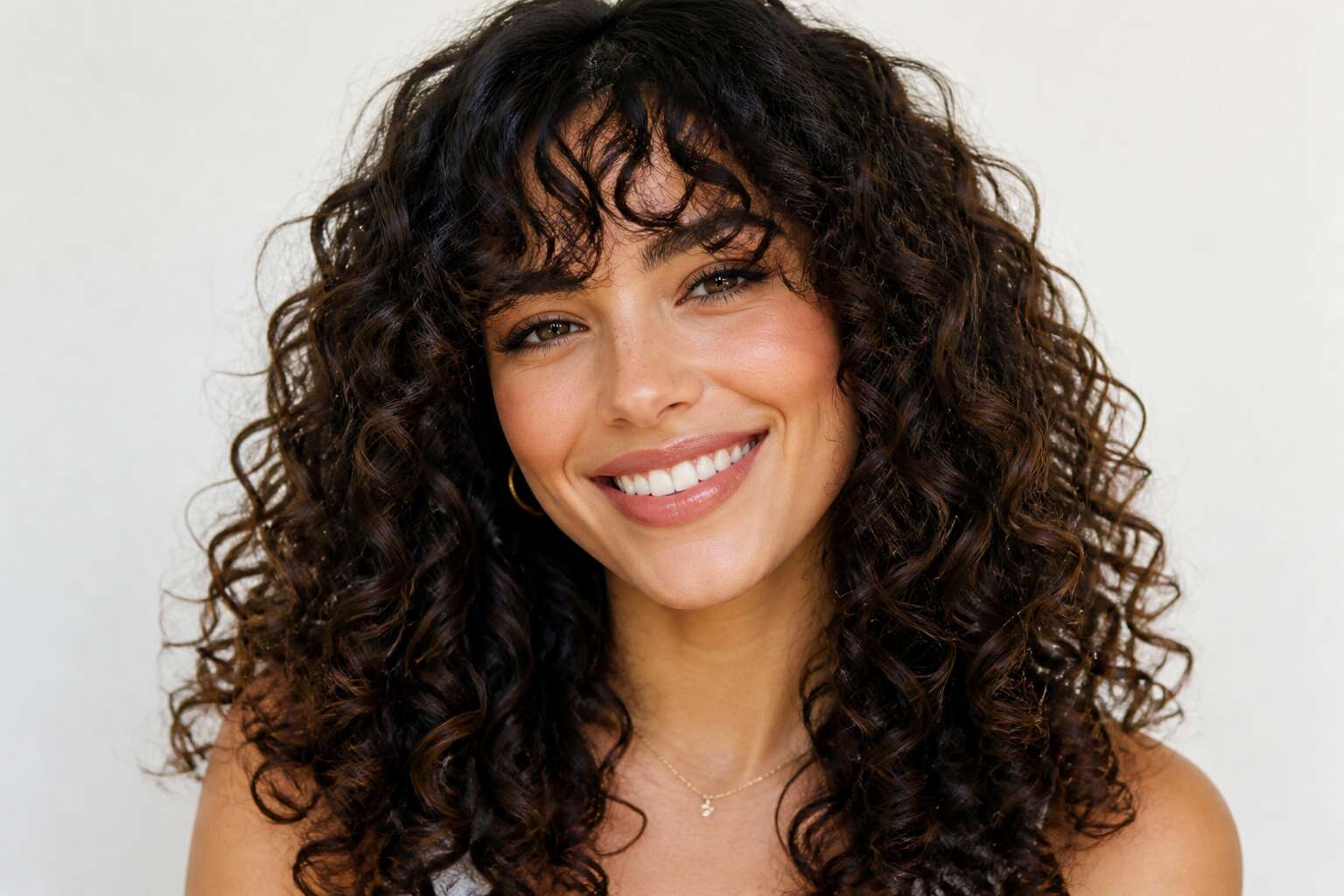
Understanding Curly Hair and Bangs
Why Bangs Are a Viable Option for Curly Hair
Curly hair is seen as a discipline problem, not a style option. The question, can curly hair have bangs, feels risky. The risk comes from misunderstanding the curl pattern. Curly hair has a memory. It snaps back to its own shape. That memory can create bangs that move with your face instead of fighting it.
Bangs are a viable option for curly hair because they add structure without stripping texture. A skilled stylist cuts each strand at an angle, respecting the coil’s natural fall. The result is a fringe that dries quickly and frames the eyes. In South African humidity, this is practical. You avoid the wet look that straight bangs often suffer.
When you ask, can curly hair have bangs, the answer depends on technique. With a dry cut and proper styling, the bangs will hold their shape. They become a feature, not a flaw!
Debunking the Myth That Curls and Bangs Don’t Mix
The notion that curls and bangs cannot coexist is a relic from an era when stylists treated curly hair as a problem to tame. That mindset created the myth. People ask, can curly hair have bangs, and they immediately picture frizz or an unflattering triangle. But that vision comes from cutting wet hair or forcing it straight, not from understanding the coil itself.
A curly strand has a natural rhythm. It contracts and expands based on moisture, humidity, and the way it is cut. When you respect that rhythm, bangs become a graceful addition. They can be curled, clipped, or left to drape. The myth persists because straight bangs set the default expectation. Curly bangs do not conform to that template, yet they offer a softer, more organic frame for the face.
- Curly bangs hold their shape without heat tools.
- They work with the hair’s natural movement.
- They can be cut to suit any curl type, from loose waves to tight coils.
So, can curly hair have bangs? The evidence says yes. The myth is just a leftover rule from a straight hair world. Curly bangs require a different eye, but the result is worth discarding that old assumption.
The Importance of Curl Pattern and Density in Bang Design
Understanding curly hair and bangs begins with curl pattern and density. The pattern controls shrinkage, so a tight coil may lose half its length when dry. Density dictates the weight and movement of the fringe. In my experience, I have never found a one size fits all approach! I assess three details before cutting:
- The coil size, which determines shrinkage
- The hair’s density at the hairline
- The natural growth direction
These details decide whether bangs will lie softly or spring forward. So when a client asks, can curly hair have bangs, I do not look at a magazine photo. I look at the hair itself. A thin density needs a smaller section to avoid a sparse look, while a thick density can handle a wider sweep. Each pattern requires its own geometry.
How Face Shape Influences Bang Suitability for Curly Hair
Face shape defines the limits of a successful bangs cut. A client might love curly bangs, but the true question, can curly hair have bangs, depends on the fringe interacting with the face’s contour. Long faces gain balance from side swept curls adding width. Round faces need vertical lines, so bangs rising at the root outperform flat sections.
Three observations guide my assessment:
- The width of the forehead versus the cheekbones.
- The presence of a strong jawline or a softer chin.
- The proportion between the hairline and the overall face length.
These elements either harmonize with curly bangs or create dissonance. A narrow forehead with dense coils can produce an overly rounded outline, while a broad forehead suits a fuller fringe. Curl shrinkage adds another consideration, but face shape remains the primary factor. The answer to can curly hair have bangs becomes matching curls to facial structure, not trends.
Choosing the Right Bang Style for Your Curl Type
Curtain Bangs for Loose Waves and Wavy Hair
“The secret to great bangs is understanding your curl’s memory,” says Cape Town stylist Roxy Meyer. Wavy hair holds a style differently than tight coils, especially in humid coastal air. For loose waves and wavy textures, the answer to can curly hair have bangs is a definitive yes, provided you select the right cut.
Curtain bangs remain the most forgiving option for this curl type. They part in the middle and sweep away from the face, which means they do not need to blend perfectly with your natural part. The key is cutting them dry, as wet waves shrink and distort the final length. A stylist should section the hair carefully, pulling each strand forward at a 45 degree angle to control the fall.
The products you use dictate the final shape. A lightweight mousse adds definition without weighing down the wave. A curl cream with a medium hold keeps the fringe from splitting into stringy pieces. Stay away from heavy gels that make the hair stiff and unnatural.
– A diffuser with a low heat setting helps the bangs dry in their natural direction.
– A small round brush can smooth them out for a softer, more blended finish.
– A texture spray adds grip for thicker wavy hair that tends to fall flat.
Curtain bangs also soften a strong jawline and draw attention to the cheekbones. They frame the face without hiding the rest of your curls. The movement of loose waves mimics the gentle fall of the fringe, creating a cohesive look that feels effortless. For those who want a change without a full restyle, this is the most practical route.
Pixie and Wispy Bangs for Tight Coils
“Shrinkage is the first thing I measure,” says Durban stylist Lindiwe Nkosi. For tight coils, the question, can curly hair have bangs, depends entirely on the cut’s tolerance for contraction. Pixie bangs, cropped above the brow, and wispy bangs, sliced into fine strands, avoid the heavy block that dense coils often default to.
These styles excel on tightly curled hair because they reduce bulk at the hairline. A stylist should cut dry, using point cutting to feather the ends. The fringe then springs into a soft, airy shape instead of a stiff curtain. Wet cutting is a mistake, since the hair will bounce up and reveal an unintended length.
If you have tight coils and want a fringe, the honest answer is yes! Provided you pick a pixie or wispy cut that works with shrinkage, not against it.
Long, Side-Swept Bangs for Medium Curl Textures
A blunt fringe is the wrong tool for medium curl textures. The weight of the curl pulls it into a heavy triangle. So can curly hair have bangs? Yes, when the fringe is long and side-swept. These bangs start at the crown and sweep across the brow. You can tuck them behind an ear or let them fall free.
Medium curl textures occupy a middle ground. They carry enough weight to hang, but enough spring to move. The cut works because it respects the curl’s natural behaviour:
- The longer length keeps the hair’s weight.
- The side sweep follows the eye’s natural line.
- The blend into side layers removes any harsh edge.
In my experience, dry cutting is standard for this style. The stylist uses the fall of the curl as a guide. The fringe moves with your pattern, not against it. So can curly hair have bangs? A confident yes, as long as the cut leans into the curl’s own logic!
Full Fringe Options for Dense, Springy Curls
Dense, springy curls demand a bold approach. A full fringe on this texture can absolutely work, but only with precision. The cut happens on dry hair, with each coil shaped individually. The result is a rounded, graphic frame that adds personality to your curls.
Keep these points in mind:
- Find a stylist experienced with curly textures.
- Expect the fringe to shrink significantly.
- Plan for monthly touch ups.
A full fringe works best for those who enjoy a statement look. The density gives it structure, while the spring keeps it lively. So can curly hair have bangs? For dense, springy curls, yes, when you embrace the maintenance.
Avoiding the Triangle Effect: Matching Bangs to Hair Volume
Your curl pattern dictates the bang blueprint, but volume decides the geometry. The triangle effect happens when bangs are too thin for dense hair, causing the sides to flare outward. To avoid this, consider how much bulk your curls carry. Thick, voluminous hair needs substantial bangs, often cut in a crescent shape. Fine curls require lighter, wispier edges to prevent weighing down.
Can curly hair have bangs? Yes, but only if you respect the hair’s natural distribution. Here is a quick check:
- If your hair expands at the temples, ask for rounded bangs.
- If it sits flat on top, add layers to create lift.
The goal is balance, not uniformity. Match the bang’s width to your hair’s volume, and the triangle is avoided.
The Cutting Process for Curly Bangs
Why Dry Cutting Is Essential for Curly Hair Bangs
In the dim light of a salon, the shears move through dry curls with deliberate precision. Dry cutting is essential for curly hair bangs because wet strands deceive, stretching into false lengths that snap back upon drying. The stylist sculpts with careful attention, allowing the curl’s natural contraction to guide every snip. This method reveals the true fall of the fringe, preventing tragic shrinkage. For those who wonder can curly hair have bangs, the answer lies in this artistry. The process demands patience:
- Observe the curl’s resting state before any cut.
- Section the hair to control the shape.
- Snip vertically to soften the edges.
Each movement preserves the balance between volume and face-framing grace. Without dry cutting, the fringe becomes unpredictable. With it, the bangs emerge as a deliberate, beautiful statement.
How to Section and Shape Bangs for Natural Curl Flow
Sectioning curly hair for bangs requires a steady hand and a keen eye for the curl’s natural parting. The stylist begins by isolating a triangular section from the crown, ensuring the width matches the desired fringe. This triangle respects the hairline’s pattern, allowing each curl to fall naturally. From there, the shape emerges through tiny vertical snips, not blunt cuts.
The process follows a deliberate sequence to honor each coil’s individual behavior:
- Identify the curl’s direction at the forehead.
- Lift each strand at a 45 degree angle.
- Cut into the curl, not across it.
- Let the spring settle before trimming further.
This method answers the question can curly hair have bangs with quiet confidence. I have seen the difference in how the fringe moves at a Johannesburg salon. The result is a shape that flows with the curl, not against it.
Working with a Stylist Who Specializes in Curly Hair
Can curly hair have bangs? A specialist who works exclusively with curls treats the fringe like a living thing. The cutting process begins with a dry consultation. Your stylist studies how each coil bends and springs before making a single snip. This observation answers the question with a resounding yes, provided the right hands guide the scissors.
The actual cutting is a slow dialogue. The stylist lifts a strand, checks its natural fall, and cuts with the blade angled into the curl. They rarely use a comb, relying on their fingers to feel the texture. The process follows a rhythm:
- Trim the perimeter first to establish the shape.
- Then release each curl from its neighbor to see true length.
- Finally, refine any stragglers after the curls have settled.
Each step respects the curl’s memory. A generalist might rush this. A specialist never does.
Styling and Daily Care for Curly Bangs
The Curly Girl Method Approach to Bang Maintenance
Few things humbled me like the first time I tried to tame curly bangs. They demanded attention every single morning! The Curly Girl Method offers a way, but only if you accept that your fringe is a living entity, not a fixed style. For those still asking can curly hair have bangs, the answer lives in how you treat them daily.
Washing with a sulfate free cleanser or conditioner is only the beginning. Plop your hair gently, then let the bangs air dry while you apply a light hold gel. Refresh on day two by spritzing water and scrunching upward. This routine keeps the curl pattern intact without stripping moisture.
- Finger coil each bang section while wet.
- Resist touching them throughout the day.
- Sleep on a silk scarf to preserve definition.
The method teaches restraint. You cannot force a curly bang into submission; you work with its texture. That daily negotiation, between control and surrender, defines whether the look truly works for you.
Products That Define Curly Bangs Without Weighing Them Down
Selecting products for curly bangs is a pursuit of balance. Heavier creams promise definition but often deliver a greasy helmet by midday. The marketplace is full of such seductive failures.
The principle is simple: seek out formulations where water is the first ingredient listed. Lightweight mousses offer hold without the crunch, while a touch of aloe vera based gel can tame the odd renegade frizz. Ingredients like marshmallow root or flaxseed provide structure without the heavy residue.
– Curl creams with a liquid, lotion consistency
– Volumizing mousses for fine curl patterns
– Gels with a flexible, cast free finish
Those with high density curls may find a pea sized amount of a heavier butter necessary for their ends. Loose waves, however, should stick to airy foams. The product choice is a dialogue with your specific texture, and the correct answer to the question of whether can curly hair have bangs is often found within that conversation.
Heat-Free Styling Techniques for Defining Bangs
In the quiet calculus of a morning routine, the time spent styling bangs often outweighs the hours you actually wear them. For those with curls, the process is less about forcing a shape and more about coaxing the hair into remembering its natural pattern. The question of whether can curly hair have bangs is answered daily in the mirror, through the deliberate rituals of refreshing and finger coiling. It is not about perfection, but about the willingness to work with the hair’s inherent memory, which resets every time you sleep.
The heat free approach begins the night before. Pineappling, the act of gathering curls loosely at the crown of the head, preserves the delicate bend of the fringe. A silk scarf or a satin bonnet reduces friction, which is the primary enemy of a defined curl. When morning arrives, the curls have shifted, but they retain their core form. The next step involves a spray bottle filled with water. Dry bangs are rigid bangs, so a thorough misting reactivates the curl train without dismantling it entirely.
1. For tighter coils, use a fine mist and scrunch upward gently.
2. For looser waves, rake fingers through the dampened fringe to break up clumps.
3. For medium textures, smooth a drop of water over the surface to calm the canopy.
The final act is patience. Touching drying curls is the most common way to introduce frizz and ruin the effort of the prior twenty minutes. Allow the bangs to air dry completely, then use a light shaking motion at the roots to separate the curls for volume. This regimen, repeated consistently, transforms the daily anxiety about a misbehaving fringe into a manageable, even meditative, part of the day. This entire rhythm is a testament that the answer to can curly hair have bangs is not merely a style choice, but a lifestyle adjustment that rewards those who embrace the slow, deliberate pace of natural styling.
Refreshing Curly Bangs on Non-Wash Days
Refreshing curly bangs on non wash days is where the real commitment is tested. The humidity in Johannesburg or Cape Town can make a tired fringe go rogue by midday. The goal is not to wash the hair again, but to persuade the curls to wake up without losing their shape. A small spray bottle with plain water is the only tool you truly need. Mist the bangs until they are damp, not soaked, and gently scrunch them upward toward the scalp. This motion recalls the curl pattern without disturbing the rest of your carefully preserved style.
Some find that a watery leave in conditioner mixed into the spray provides extra grip for curls that have gone limp. For the days when the fringe needs a quick revival, consider the specific texture you are working with:
- For fine wavy bangs, a quick spritz and a few finger twists define the bend.
- For medium curls, focus the water on the roots to lift the hair away from the forehead.
- For tight coils, a diluted cream smoothed over the ends prevents the fragile tips from drying out.
The air in South Africa can be dry, especially in the Highveld, so re wetting the bangs daily is a practical ritual, not a burden. The answer to the question of can curly hair have bangs depends heavily on this routine of refreshment. Without it, the fringe becomes a separate, unruly entity. With it, the bangs integrate back into the rest of the hair, maintaining a cohesive look that lasts several days between washes. The key is to treat the bangs as the most delicate part of the whole head, because they are.
Troubleshooting Common Bang Problems
Dealing with Frizz and Shrinkage in Curly Bangs
For anyone asking if you curly hair have bangs, the daily reality often involves a battle against the elements. Frizz is the primary adversary, turning a defined fringe into a fuzzy halo within hours of stepping outside. Shrinkage, meanwhile, makes your carefully cut bangs retreat up your forehead, altering the intended shape entirely. These issues are not failures of the hairstyle itself, but rather the predictable results of moisture loss and the natural elasticity of your hair.
The solution lies in a routine built on strategic hydration and careful handling. Here is a list of common missteps that sabotage curly bangs:
1. Touching them constantly throughout the day to check their shape.
2. Using a regular towel to dry them, which roughs up the cuticle.
3. Applying styling products to soaking wet hair without a defined method.
4. Sleeping on a cotton pillowcase that wicks away essential oils and moisture.
Instead, think of your bangs as a separate entity requiring specific care. A leave-in conditioner with a heavier hold, applied when the hair is damp, is your first line of defence. You must resist the urge to fix them with your fingers. Once they dry, the curl pattern is set, and interference only invites frizz. For the necessary refresh on a Tuesday morning, a spray bottle with water and a tiny amount of conditioner is more effective than any gel or mousse, which can dry out and flake.
How to Blend Bangs into the Rest of Your Curls
For anyone still asking can curly hair have bangs, the real comedy begins when your fringe decides to secede from the rest of your curls. One moment you have a unified head of spirals, the next your bangs dry into an isolated puffball that refuses to acknowledge its neighbours. This fragmentation is common, and it stems from the simple fact that shorter hair dries faster and responds to gravity differently than longer lengths.
The key to blending bangs into the main mass is to treat the transition zone as a negotiation, not a battle. After applying your defining product, use a fine tooth comb to gently merge a few strands from each side, then let them dry together. Resist the urge to over style, as excessive manipulation creates the very separation you are trying to avoid.
- Never cut bangs in isolation; always check them against the surrounding curl pattern.
- Avoid using different products on bangs versus the rest, which creates texture mismatch.
- When in doubt, wet the bangs and scrunch them with the adjacent curls to reset the alliance.
Once you accept that bangs are not a rogue element but an extension of the same curl family, the entire style comes together. The goal is not to force them into identical shape, but to let them communicate with each other through shared moisture and gentle encouragement.
Grow-Out Strategies for When You’re Ready to Change Your Look
Six months in, your fringe does what it wants. It waves where it should curl, flattens where it should spring. The question, can curly hair have bangs, stops being about style and becomes about survival. Shrinkage makes them look shorter than intended. Frizz sets in when the canopy rubs against your forehead all day.
- Shrinkage distorts the shape you saw in the mirror.
- Humidity fuses spirals into one dense clump.
- The transition zone between bangs and longer curls loses rhythm.
Grow-out strategies shift the approach. You stop seeing the in-between phase as a mistake. A jaw clip keeps the fringe out of your eyes. Twisting the ends with the side curls hides the length.
Accept that the answer to the question can curly hair have bangs is yes. Maintenance is a conversation. Some days it goes well. Other days you wear a headband and wait.


0 Comments