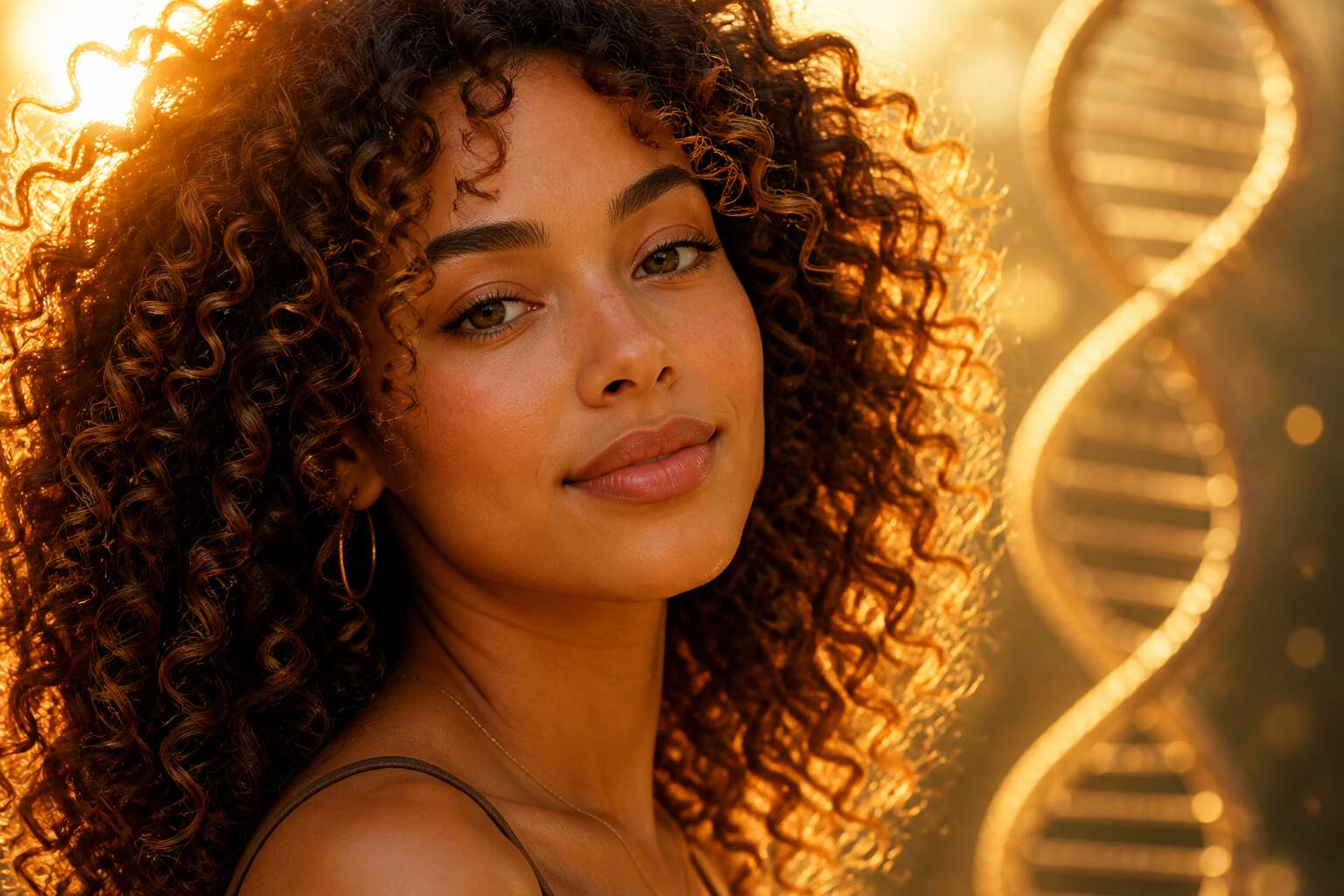
The Genetic Foundations of Hair Texture
What Determines the Shape of Your Hair Follicle
One in five people worldwide will never possess a single perfectly straight strand. The geometry of your hair begins deep within the follicle, long before a single keratin protein is ever deposited. The shape of that follicle is a physical testament to your ancestry, a grammar written in cellular mechanics. A straight follicle produces a round fiber, while an oval or twisted bulb forces the strand to bend as it grows, creating waves or tight coils. The angle at which the follicle sits in the dermis and the distribution of keratinization along its length determine whether you are looking at a beach wave or a spring.
This architecture is not random. The genetic signals that govern follicle shape are complex and often misleading when viewed through a simple family tree. Many people assume that are curly hair genes dominant, but the reality is that no single gene holds a monopoly on curl. Instead, variations across multiple chromosomes, particularly in the trichohyalin gene, work in concert. These variants influence the proteins that reinforce the hair shaft, and their inheritance patterns do not always follow a clean Mendelian ratio.
To understand what you are working with, consider the visible evidence of your own genotype:
– The diameter of the individual strand, which dictates overall volume.
– The uniformity of the curl pattern from root to tip.
– The presence of a medulla, the central core, which is often discontinuous in curly fibers.
– The level of disulfide bonding, which creates the internal tension that forces the bend.
What we often call dominance in this context is really a matter of penetrance. A person can carry the genetic coding for tight curls and still exhibit nearly straight hair if the expression of those genes is suppressed by other modifying factors. The conversation around whether are curly hair genes dominant misses the provincial nature of inheritance. It is a polygenic trait, meaning your hair texture is the average of many small pushes and pulls from both parents, rather than a binary switch. The follicle simply obeys the final count of these signals, crafting a shape that is uniquely, statistically yours.
Keratin and Trichohyalin: The Proteins Behind Curl
Hair is a fabric woven from two primary proteins, and their balance is the true architect of curl. Keratin, the structural backbone, is produced in the cortex of the follicle, while trichohyalin acts as the binding agent that helps keratin filaments align. In straight hair, these filaments pack into a dense, orderly matrix. In curly hair, the keratinization process is asynchronous, meaning different parts of the strand harden at different rates, causing the fiber to buckle as it emerges from the scalp.
This molecular choreography is where the answer to whether are curly hair genes dominant begins to emerge. Trichohyalin variants are heavily implicated in determining the final shape, but they do not operate alone. The level of disulfide bonding, the chemical glue that gives hair its resilience, also plays a role. More disulfide bonds create greater internal tension and a tighter curl pattern, while fewer bonds allow the hair to lie flat.
The genetic instructions for these proteins are inherited from both parents, but the expression is highly individualized. Consider the observable factors at play in your own hair:
1. The concentration of trichohyalin, which can vary from follicle to follicle.
2. The rate of keratin deposition, which controls the stiffness of the shaft.
3. The pattern of disulfide bond formation, which dictates the spring of the coil.
These protein interactions blur the lines of simple dominance. The question of are curly hair genes dominant becomes less about a single winning trait and more about the cumulative output of these proteins. A person may inherit a strong curl coding from one parent, but if the modifying proteins from the other parent dilute the keratin matrix, the result is a looser wave. The final texture is a biochemical compromise, not a verdict. This is why two siblings can share the same parents and yet produce completely different hair types, each strand a unique expression of the same genetic library, which is a common reality in South Africa’s diverse population.
How Gene Variants Influence Follicle Asymmetry
Over90% of the global population carries at least one gene variant influencing hair shape, yet the physical output is rarely an all or nothing affair. The real story of whether are curly hair genes dominant is written in the geometry of the follicle itself.
A straight follicle grows vertically from the scalp. A curly follicle bends at an angle before the strand even emerges. This asymmetry is influenced by specific variants that alter the distribution of cells in the dermal papilla.
Three primary variants drive this process:
1. The TCHH gene, which regulates the inner root sheath’s stiffness and determines the angle of the bend.
2. The EDAR gene, which controls the thickness and curvature of the shaft.
3. The WNT10A gene, which influences the proliferative phase of the follicle cycle.
Each of these variants acts on a sliding scale. If you inherit a strong bend coding from one parent and a weak one from the other, the follicle settles somewhere between the two. The final shape is a quantitative result, not a verdict. That is why the question of are curly hair genes dominant misses the mark. Dominance implies a winner. Here, the follicle often splits the difference.
The asymmetry itself is fixed at birth, but its expression can vary across the scalp. You may possess a mix of follicles with different angles. This is a common reality in South Africa, where mixed ancestry frequently yields a spectrum of curl patterns on a single head. The genes do not argue for one texture. They compromise, producing a population whose hair density and follicle shape defy simple categories.
Understanding Alleles: The Building Blocks of Inheritance
Every gene arrives as two copies, called alleles, one from each parent. When the copies differ, the question of whether are curly hair genes dominant becomes central. For many traits, one allele silences the other completely. That is dominance. Hair texture, however, uses a more cooperative system.
Studies across Sub-Saharan Africa, including South African cohorts, show hair shape genes often behave additively. Each allele contributes a measurable effect. Three inheritance patterns explain most outcomes:
- Partial dominance, where the physical result falls between the two alleles.
- Additive inheritance, where both alleles contribute equally.
- Polygenic interaction, where multiple genes shape one visible texture.
A child in Johannesburg with one parent of tight coils and one of straight hair often displays neither exactly. The alleles recombine into a unique compound. I keep returning to this whenever people ask are curly hair genes dominant. Inheritance rarely allows a single gene to rule.
Decoding Dominance and Recessiveness in Human Traits
A Brief Recap of Mendelian Dominance
Mendel’s experiments gave us the language of dominance, but reality is messier. Dominance refers to which allele gets expressed, not which trait is more common. This matters when we ask are curly hair genes dominant. Curly hair does not follow a simple dominant or recessive rule.
Think about inheritance across generations. A single gene rarely decides curl. Multiple alleles and environmental factors shape the outcome. Classic Mendelian ratios apply to single traits, yet hair texture behaves like a polygenic puzzle.
Dominance in practical terms:
- One dominant allele produces its trait.
- Two recessive alleles are required for the recessive trait.
- A heterozygote carries both but shows the dominant form.
These buckets oversimplify human genetics. Many variants show incomplete dominance, where the heterozygote blends features. So curly hair genes might act dominant in one family and recessive in another. Are curly hair genes dominant? It depends on the specific alleles involved.
Complete, Incomplete, and Co-Dominance Explained
Complete dominance means one allele overrides its partner entirely. Incomplete dominance blends the two contributions, so a heterozygote lands somewhere between both parents. Co-dominance allows both alleles to express themselves at once, each remaining visible in the final trait.
People who ask are curly hair genes dominant usually expect a binary answer. I find that hair texture rarely cooperates. Depending on which gene variants are involved, curl can behave like a blend, a joint expression, or a straightforward mask. A child may inherit curls softer than either parent, which points to incomplete dominance, or show distinct curl patterns across different sections of the scalp, which suggests co-dominance between alleles.
- Complete dominance: one allele suppresses the other
- Incomplete dominance: the heterozygote displays an intermediate blend
- Co-dominance: both alleles remain visibly expressed
Why Dominance Is Not Always a Simple On/Off Switch
Dominance in human traits is rarely a clean proclamation. Recessive alleles persist through generations of carriers, unexpressed but present. When two carriers produce a child, the hidden variant can surface without warning. This is why asking are curly hair genes dominant invites an unsettled answer. The trait appears, disappears, and reappears in patterns that look almost deliberate.
- One child may inherit two different curl alleles and show an intermediate texture.
- Another may express one allele on one side of the scalp and a different pattern elsewhere.
- A third may carry the gene for curls yet never show it.
Dominance, then, is a matter of context. It depends on the partner allele, the genetic background, and the unpredictable chemistry of each new generation. For every seemingly simple dominant trait, there are exceptions hiding in the bloodline.
The Role of Autosomes and Sex Chromosomes in Hair Genes
Hair texture inheritance doesn’t follow the same rules as sex-linked traits like baldness or color blindness. Those conditions travel on the X chromosome, which means fathers pass them to daughters and mothers pass them to sons. Curly hair genes live on autosomes, the 22 pairs of chromosomes that both parents contribute equally. This changes how the question “are curly hair genes dominant” plays out in a family tree. A child receives one copy of the relevant gene from each parent, and both copies carry equal weight regardless of the child’s sex.
The genetic map for curl is more complex than a single autosome location. Researchers have identified variants on chromosome 1, particularly near the trichohyalin gene, that influence follicle shape. These variants interact with other regions across the genome to produce the final texture. The X chromosome does carry some genes related to hair structure, but they play a supporting role rather than a deciding one. The autosomes do the heavy lifting.
– Autosomal genes: each parent contributes one allele, and the combination determines expression.
– X-linked genes: males inherit one copy from their mother, females inherit two.
– Environmental factors: hormone shifts and age can alter how strongly the inherited alleles express.
This autosomal distribution explains why a child can have tighter curls than either parent. Each parent may carry a recessive curl allele alongside a dominant straight allele. When both pass the recessive variant, the child receives two copies and expresses full curls. The sex of the child never enters the equation. So when people ask are curly hair genes dominant, the honest answer is that the location of the gene matters as much as the allele itself. The autosomes level the playing field between mothers and fathers, and the X chromosome adds a minor layer of influence.
How Curly Hair Is Actually Inherited
Is There a Single ‘Curly Hair Gene’?
If you are waiting for a tidy answer to the question are curly hair genes dominant, you will be disappointed. There is no single curly hair gene to pin that label on. Curly hair inheritance is polygenic, meaning multiple genes cooperate to shape your follicle and determine its angle of growth. This is why two straight-haired parents can produce a curly-haired child, and why siblings often end up with entirely different textures.
Several realities complicate any dominant or recessive story:
- Different gene variants associate with curl in different populations, so no universal curly allele exists.
- Some genes influence the follicle directly, while others act on nearby proteins or growth cycles.
- Environmental factors during development can modify how those genes express themselves.
So when someone demands a straight answer, I explain that asking are curly hair genes dominant is the wrong question. The honest response depends on which gene, which population, and which curl trait you measure. The classic single-gene model cannot capture that nuance.
Polygenic Inheritance and the Spectrum of Hair Curvature
When people ask are curly hair genes dominant, they expect a simple yes or no. But the real inheritance pattern is more like a blending of many small contributions. Each gene adds a small effect, and together they shape the arc of your hair.
Polygenic inheritance means no single switch decides your texture. Instead, you find a spectrum of curvature, from barely there waves to tight coils. This is why a family can display nearly every curl pattern across one generation.
- One gene may affect follicle angle.
- Another alters the way keratin bonds.
- A third tunes the growth cycle.
South African hair textures demonstrate this beautifully, with roots in diverse populations that carry distinct variant mixes. So the question of dominance becomes less about one gene and more about how many pieces of the puzzle you inherited.
Predicting Offspring Hair Texture: A Punnett Square Reality Check
When someone asks if curly hair genes are dominant, they often picture a simple Punnett square from school. You know the one, where a single trait gets neatly boxed into dominant and recessive squares. For hair, that tidy diagram collapses. Predicting offspring hair texture with a single cross is an illusion, because the trait does not follow a monohybrid pattern. The reality is that each parent contributes a constellation of alleles, and the final expression is a weighted sum of those contributions.
To see why a Punnett square fails, consider what it actually predicts. It works for traits like pea pod color, where one gene holds all the power. For hair, that square would need thousands of rows. The texture you see in a child is a composite score. If you want something closer to a truth table, think of it less like a genetic coin flip and more like a mix of paint. The exact shade of curl depends on the specific quantities and combinations inherited.
Here is what a realistic predictive model looks like, based on our current understanding:
– Genotype for follicle shape genes contributes the base curvature.
– Variants in keratin protein structure add or subtract springiness.
– The expression level of trichohyalin genes influences strand thickness.
– Parental variants that affect growth cycle timing modify the overall pattern.
A child with straight-haired parents can have a curly-haired child if both parents carry hidden recessive variants that combine. Likewise, two curly parents can produce a straight-haired child when the specific dominant alleles do not align. The question of are curly hair genes dominant, therefore, only holds for individual loci, not for the trait as a whole. The outcome is probabilistic, not deterministic.
Beyond Genetics: Environmental and Epigenetic Influences
Hormonal Shifts and Their Effect on Hair Curl Patterns
Ever notice your curl pattern morph after a major hormonal event? I have seen clients whose straight hair turned wavy during pregnancy, then reverted. This fluidity reveals why the simple question, are curly hair genes dominant, misses the full picture.
Epigenetic modifications, triggered by stress, diet, or climate, can silence or amplify gene expression without altering the underlying DNA sequence. Hormonal shifts like thyroid fluctuations or androgen changes reshape the follicle’s architecture over time. The dermal papilla directs hair growth and responds to these signals by altering follicle curvature.
- Postpartum estrogen drops
- Menopause-related androgen shifts
- Thyroid hormone imbalances
These influences can switch curl types in adulthood, proving that gene dominance is just one chapter in a complex story.
Hair Care Routines That Temporarily Alter Natural Texture
Across South Africa, from Cape Town’s coastal humidity to the Highveld’s dry winters, hair responds to shifts in the air. Water quality, sun exposure, and washing frequency can flatten or coil strands. These environmental cues interact with your follicles in ways that make the question, are curly hair genes dominant, seem overly simplistic. The same head of hair can look ringleted on a misty morning and nearly straight after a week of hard water.
Hair care routines also stage a temporary interference. Products with sulfates or silicones alter the cuticle’s moisture balance. Heat styling breaks hydrogen bonds, reshaping the cortex until the next wash. These effects do not touch your genotype, but they convincingly mimic a new inheritance. Here is what often modifies texture:
- Bleaching or relaxing treatments that swell and reconfigure protein links
- Braids or twists that set a temporary wave pattern
Aging, Nutrition, and the Changing Shape of Your Strands
As we age, the follicle’s dermal papilla shrinks and the hair shaft naturally thins. This shift can relax a tight coil or add a kink where none existed. In South Africa, where sun exposure is fierce, we see this structural wear happen sooner. The static answer to are curly hair genes dominant starts to lose its certainty when a 50-year-old sees her defined ringlets turn into gentle waves.
- Reduced melanin production altering the strand’s density
- Slower cell turnover in the scalp’s sebaceous glands
- Nutritional gaps, especially iron and vitamin D
Nutrition exerts a subtle, long-term effect. Low protein intake limits keratin synthesis, while zinc deficiency distorts the follicle’s rotation. Epigenetic marks, triggered by chronic stress or environmental pollutants, can silence or amplify a curl-related gene without changing the underlying DNA. So the question are curly hair genes dominant remains relevant, but your lived environment alters whether a curl gene switches on or off every single day!
Epigenetic Modifications: How Lifestyle Can Switch Genes On or Off
Every day, my scalp absorbs Cape Town’s UV intensity. The static answer to are curly hair genes dominant crumbles against epigenetic modifications. Lifestyle factors, such as chronic psychological duress, initiate chemical tags that bind to the gene and silence it.
Consider DNA methylation. This process physically mutes the curl gene without altering the sequence. Your lived stress becomes a biological instruction. The science of whether are curly hair genes dominant predicts inheritance, yet it fails to predict your daily expression. The mechanics of the follicle respond to these direct biological signals.
What triggers these switches?
- Heat shock proteins from extreme thermal stress.
- Airborne pollutants causing oxidative damage.
- Circadian disruption altering follicle cycling.
I find this haunting. You might inherit the exact curly allele, yet a harsh South African environment condenses that region into heterochromatin. Thus, each strand reflects ancestry alongside your visceral survival.
What Commercial Genetic Tests Reveal About Hair Traits
Commercial genetic tests scan for SNPs in genes like TCHH and EDAR, offering a percentage likelihood of curly hair. The question of are curly hair genes dominant appears in the fine print, yet the report frames results as probabilities, not verdicts. This distinction matters in South Africa, where mixed ancestry produces overlapping signals.
These tests measure inherited variants, but they cannot observe your follicle in real time. They miss environmental inputs:
- Seasonal humidity shifting the hydrogen bonds in your cortex.
- Chemical relaxers altering the protein matrix.
- UV damage changing strand porosity.
Your test result and your mirror can disagree. The variants answer are curly hair genes dominant in a laboratory sense, but the lived answer depends on the climate and the products you choose.
The Latest Scientific Consensus on Curly Hair Dominance
Your genome holds the blueprint, but it is not the builder. Scientists now view hair texture as a dynamic trait, not a fixed inheritance. The question of are curly hair genes dominant loses force when we account for epigenetic markers. Methyl groups attach to DNA and change how genes are read without altering the sequence.
Stress hormones, nutritional gaps, and long term chemical exposure can all shift follicle behaviour. In South Africa, where hair care routines differ sharply across communities, these inputs vary enormously. The latest scientific consensus treats dominance as a measure of potential, not destiny. Your follicle responds to its environment, and your curl pattern reflects that ongoing dialogue.
Separating Hair Genetics Facts From Fiction
The One-Gene-One-Trait Fallacy in Hair Curl
One gene, one trait. It made genetics easy, but it was never true. Hair curl illustrates the fallacy perfectly. Dozens of loci across your genome influence follicle shape through small additive effects. The old framework simply cannot explain the observed spectrum.
So when people ask are curly hair genes dominant, they treat dominance as a property of the whole trait. It is not. Dominance operates at the level of a single gene pair. Curl genes vary in their allelic relationships, some recessive, some additive, some with partial suppression.
- Certain variants act through epistasis.
- Others respond to hormonal cues.
- A few show variable penetrance.
None of these fit the one gene, one trait model. The fiction collapses under this complexity.
Why Siblings Often Share the Same Parents but Not the Same Curl
Two siblings can share the same parents, the same household, even the same DNA test results for health risks. Yet one has a head of tight coils and the other has pin-straight locks. This observation leads many to ask are curly hair genes dominant. The answer is more complicated than a simple yes.
Curly hair genes act independently across your genome. Each parent carries two alleles for every relevant locus. They pass only one copy to each child. Which copy you receive is a random draw. This is why siblings inherit different combinations from the same gene pool.
Dominance only applies to a specific allele pair. A variant can be dominant at one locus and recessive at another. Heterozygosity often produces an intermediate phenotype. Expression varies with genetic background and hormonal environment. So the question are curly hair genes dominant becomes an oversimplification.
– Consider two siblings with the exact same curly hair mutation.
– One expresses strong coils, the other shows only subtle waves.
– Variable penetrance and expressivity explain this gap.
The real answer is allele-specific, not trait-specific. Some curl variants are dominant, others are not. None of them define the whole trait. Sibling differences reveal this truth.
How Accurate Are Online Hair Type Predictors?
Online hair type predictors appeal to our craving for certainty. They ask about your parents, scan a photo, and return a confident verdict. Yet they reduce a polygenic reality to a handful of inputs. These tools often claim to answer are curly hair genes dominant in a single click. That illusion of precision hides the genetic nuance.
Consider what they ignore:
- Variable penetrance across alleles
- Hormonal changes over decades
- Epigenetic effects from lifestyle
Each factor shifts curl expression. A predictor cannot see your internal environment. It only sees surface data. For anyone wrestling with their own hair history, the honest answer is more complex than any algorithm suggests.
What Genetic Testing Can and Cannot Tell You About Your Hair
Genetic testing provides limited information. A saliva swab can identify variants in keratin or trichohyalin genes, but it cannot tell you whether those variants are active. The core question, are curly hair genes dominant, remains beyond a lab report. Dominance depends on interactions across multiple loci and environmental signals.
I have seen clients carry every curly marker in their profile, yet their strands hang straight. That happens because testing assesses your inherited code, not your current cellular activity. It cannot measure how hormones or styling habits influence follicle shape.
- It can confirm you have certain variants.
- It cannot show how lifestyle alters expression.
- It cannot predict future curl pattern.
That matters in South Africa, where hair texture diversity is wide. Do not expect to find a single dominant gene. The honest answer about are curly hair genes dominant is that dominance exists, but only in context.

0 Comments