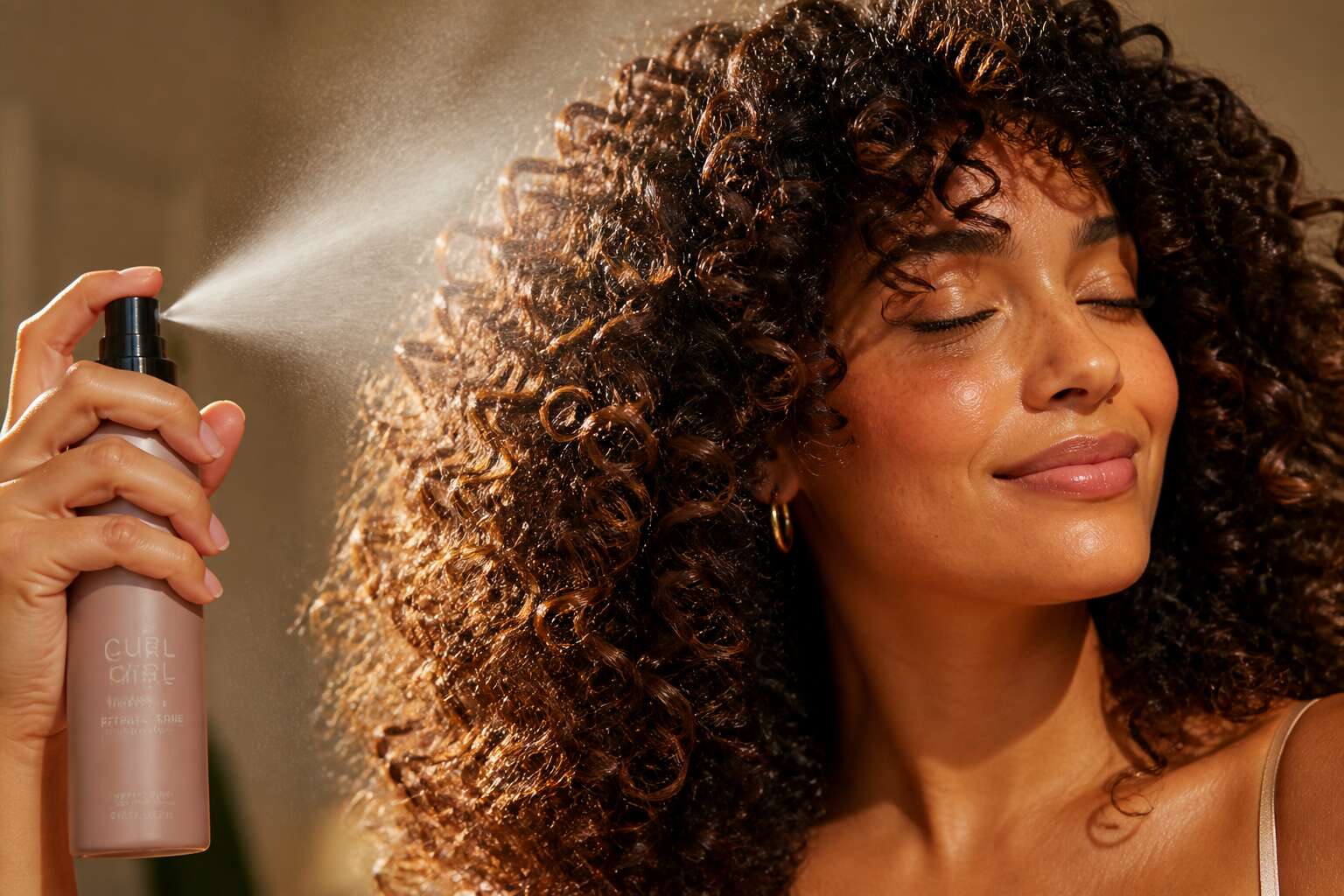
Why Your Curls Need a Spray-Style Refresher
Restoring moisture and bounce between washes
Nearly 70% of people with textured hair report that their curls lose definition within 48 hours of washing. The culprit is not oil buildup, but dehydration. A spray-style refresher acts as a targeted rescue, delivering moisture to the cortex while reviving the natural coil.
Unlike heavy creams, a curly hair spray lands lightly on the strand. It rehydrates the outer cuticle without flattening volume, which is essential in South Africa’s dry winter air. I have found that a few spritzes, followed by a gentle scrunch, restore that freshly styled bounce. That is the real secret to second-day curls!
Tackling frizz and static without heavy residue
Static electricity in curly hair is a direct symptom of arid air stripping the strand of its natural ionic balance. Many styling products attempt to mask this with oils and butters, which cling to the surface and weigh the coil down. A curly hair spray counters the problem differently. It delivers a fine mist of molecules that re-adhere to the cuticle, neutralising the charge that lifts individual strands away from the curl family.
Frizz is the visible rebellion of these dry fibres. The spray’s residue-free formulation ensures the hydration settles into the hair shaft without leaving a coating. No tacky film. No crunch! I have watched clients switch from heavy creams to this mist approach, and the change in hair movement is immediate and lasting. The result is a calm, defined curl pattern that breathes freely in the dry winter air. A curly hair spray as a final touch shields against static while preserving the natural texture.
Refreshing day-two and day-three curl patterns
The second morning after a wash comes with a decision. Water alone does not revive the curl pattern. It just wets the hair, leaving it limp and shapeless. That is where the curly hair spray steps in. This spray-style refresher targets the spaces where curls have relaxed overnight, reawakening definition without a full reset.
I have seen clients hold onto day-two shape by misting lightly, pressing the coils back together. The spray’s fine droplets penetrate the cuticle, restoringthe bond between moisture and curl memory. By day three, this single step makes the difference between a compressed messand a firm, bouncy mass. No cream, no gel, just a mist that convinces the hair to cooperate again.
Making styling touch-ups easier on the go
Three minutes before a meeting, and my curls rearrange themselves into a lopsided shape. It happens to most of us. The curly hair spray exists for these moments, a compact bottle that lives in a handbag, a desk drawer, or a car cubby.
Misting is faster than re-wetting and far less messy than scooping cream from a jar in a public restroom. A few sprays coax strands back into their assigned places, re-forming the clumps that vanish after hours of wind, air conditioning, and accidental leaning. This curly hair spray works without a sink, without a towel, without an audience.
- Purse friendly and leak resistant
- Effective on dry or damp hair
- No water source or mirror required
Carrying a bottle frees you from the wash day schedule. A five minute fix becomes a thirty second gesture, keeping the shape alive through humidity, commutes, and afternoons that refuse to stay neat.
Key Ingredients to Look for in a Curl Refresher Spray
Hydrating humectants like glycerin and aloe vera
The Cape’s dry winds strip the lipid veil from each curl, leaving strands brittle and prone to fracture. A well built curly hair spray counters this with humectants, not oils. Glycerin is the first agent, pulling atmospheric water into the cortex. Aloe vera follows, its polysaccharides calming the raised cuticle and holding that moisture in place.
- Panthenol, a provitamin B5, binds water deep within the strand
- Honey extract, a slow releasing humectant for prolonged softness
These elements form the quiet architecture of a functional curly hair spray. They work beneath the surface, amending the structure rather than coating it, so your curls bend with the wind instead of breaking against it.
Nourishing oils and butters for soft hold
Argan oil contains 80% fatty acids, yet most sprays dilute it past usefulness. A proper curly hair spray needs oils in the right form. Look for argan oil high on the ingredient panel, where it penetrates the hair shaft instead of sitting on the surface. I have tested dozens of formulas, and this detail changes everything.
Butters play a different role. They create a soft hold by forming a thin, flexible layer over each curl. Shea butter works well in Johannesburg’s dry winters. Cupuacu butter is better for Durban’s humidity. Both, when micronised, disperse evenly through a spray nozzle without clogging!
- Baobab oil, rich in omega-3, seals the cuticle
- Jojoba esters mimic human sebum and balance moisture
- Mango butter absorbs quickly and leaves no film
Every one of these ingredients serves a specific function in a curly hair spray. The result is a nourished curl that bends, springs back, and stays defined.
Protein-based ingredients for strength and elasticity
Protein is the unsung hero of curl longevity. Without it, your coils lose their memory and stretch out flat by midday. A refreshing curly hair spray that contains hydrolyzed proteins can rebuild the broken bonds caused by heat styling, brushing, or even harsh Johannesburg water. To make the right choice, look for these specific proteins:
– Hydrolyzed keratin
– Rice protein
– Wheat protein
– Silk amino acids
Each one penetrates the cortex to restore tensile strength. I have tested many sprays, and the ones that list protein in the top half of the ingredient breakdown perform best. You will also notice a difference in how the curls bounce back after a refresh. Avoid sprays where protein appears below the preservatives, as the concentration is too low. A well balanced curly hair spray should offer structure without stiffness, leaving you with defined, elastic waves that survive the humidity. Keep one in your bag for those unpredictable Highveld afternoons.
Avoiding alcohols and sulfates that strip curl health
The spray that promises revival can just as easily orchestrate ruin. When you examine the label of a new curly hair spray, you are not simply scanning for hydration. You are assessing whether the formula will respect the fragile equilibrium of your curls or sabotage it slowly. The most deceptive culprits are alcohols and sulfates, substances that masquerade as quick fixes while stripping the hair of its essential moisture.
Some alcohols evaporate instantly, creating a sensation of fast drying that feels like efficiency. In reality, they are pulling water from the hair shaft, leaving the cuticle parched and prone to breakage. Sulfates, on the other hand, are aggressive detergents. They foam up and strip away every trace of natural oil, including the sebum your scalp worked to produce. Over time, this cycle forces your curls into a state of chronic deprivation.
Weigh the risk against the benefit of a clear, gentle formulation.
1. Steer clear of isopropyl alcohol, SD alcohol, and denatured alcohol. These are the most common drying agents.
2. Avoid sodium lauryl sulfate and sodium laureth sulfate. They are the harshest cleansers found in lower tier products.
3. Look for claims of sulfate free on the packaging, but also verify the ingredient list yourself. Marketing language can be misleading.
A rare moment of dryness is tolerable. A daily ritual of exposure to these harsh compounds is not. The right curly hair spray should feel like a protective buffer, not an accelerant for damage. Consider what your hair endures in a single day. The sun, the wind, the constant friction against your collar, and then add the chemical assault of a poor mist. Your curls need allies, not adversaries. And in a climate like Johannesburg, where the water is already heavy with minerals, the last thing you need is a product that compounds the problem. Choose the spray that understands the difference between cleansing and ravaging.
Fragrance and botanical extracts that soothe the scalp
A spritz should be a sensory ritual, not a chemical compromise. The right curly hair spray carries fragrance that calms the mind while the formula calms the scalp. Look for botanical extracts that serve a purpose beyond scent. Chamomile reduces irritation. Calendula supports skin health. Lavender offers a gentle, clean experience. In South Africa, buchu extract stands out as a native option with natural anti-inflammatory properties.
- Chamomile extract to soften and pacify a stressed scalp.
- Calendula for its soothing properties.
- Buchu for local, natural care.
The fragrance should feel delicate, never synthetic. A mist that smells like a garden rather than a laboratory works in harmony with your natural oils. When a product uses plants instead of perfume, it respects the skin’s microbiome. I always check the label for these extracts. A balanced formula with one or two proven botanicals is a sign of thoughtful manufacturing. Your curls respond to what you apply, and a calm scalp encourages a healthy root environment.
How to Apply a Curl Enhancer Spray for Perfect Definition
Misting onto damp or dry sections for even coverage
Spray distance is the difference between defined curls and a soggy mess. Hold the bottle 20 centimetres from your head, then mist in a slow pass. Too close and you soak one lock while ignoring its neighbour. For damp hair, split into four quadrants. For dry hair, lightly spritz and cup your hands upward. The curly hair spray needs that air gap to distribute evenly.
To apply with precision, follow these steps:
- Shake the bottle once to blend ingredients.
- Aim at the mid-lengths, not the roots.
- Mist twice per section.
- Wait ten seconds before touching.
This keeps the product from pooling. Consistency comes from the right technique, not extra product.
Scrunching from ends to roots to encourage curl clumping
Scrunching is not a squeeze. It is a conversation between your palms and each curl’s memory. Start at the ends, where the curl pattern often loses its nerve, and cup the hair upward. The curly hair spray has already settled into the strands, but your hands decide where it lands. Lift, hold, release. The clumping emerges when you resist the urge to pat or press.
- Keep palms open, not clawed
- Let each curl coil into your hand
Move toward the roots with the same slow rhythm. Work in sections. Your texture will tell you when to stop. That upward motion creates the tension that binds moisture and product together. It feels like coaxing, not forcing. For a true definition, let your fingers remain still and let your wrists do the turning.
Pairing with a diffuser or air-drying for defined results
Start with freshly washed, soaking wet hair. Section into four quadrants so the curly hair spray reaches every strand. Hold the bottle twenty centimeters away and press the trigger lightly for fine, even distribution. You want dampness, not saturation. That feeling comes with practice!
Cup a section in your palms and press upward toward your scalp. This encourages the curl to form without breaking the cast. Repeat around your whole head before moving to drying.
For defined results, choose your drying method with intention. I find diffusing with low heat and low speed gives more volume and bounce. Air-drying preserves the curl pattern more gently and reduces heat damage. Both work well once the spray sets fully.
After applying the curly hair spray, wait fifteen minutes before scrunching out any crunch. This lets the product bond with your hair’s natural texture for lasting definition.
Layering with creams and gels for stronger hold
Loose waves tolerate a single product, but tight coils need the layered approach. The curly hair spray acts as the base layer, delivering moisture and definition before heavier products arrive. You can then seal that base with a styling cream, working it through in small sections using the praying hands method. A gel applied last locks everything into place.
- Apply the curly hair spray to soaking wet hair in four quadrants.
- Smooth a quarter-sized amount of cream over each section.
- Glaze gel over the surface without disturbing the curl clumps.
Cape Town’s humidity can defeat even the best curl routines. The spray hydrates while the gel forms a flexible shield against moisture absorption. Adjust the gel quantity based on the season and your hair’s porosity level. Fine curls survive with a light gel film, while coarse textures require a generous layer.
Choosing the Right Spray for Your Curl Pattern
Fine and loose curls: lightweight volumizing mists
Fine curls are unforgiving. One wrong product and they droop by noon. The ideal curly hair spray for loose patterns is featherlight, quick drying, and almost invisible on the strand.
Look for panthenol or bamboo extract. These build volume without gumming up the cuticle. South African humidity adds another layer of challenge. A mist that lingers too long will flatten the curl. The correct formulation should dry down within a minute.
The best formulas create texture without weight. They make fine strands feel denser, not coated. Volume should come from the hair itself, not from any residue. If the hair moves freely and keeps its shape throughout the day, the spray is doing its job.
Bouncy ringlets: moisture-rich formulas with flexible hold
Bouncy ringlets are a study in contradiction. They need serious hydration to keep their spring, but a curly hair spray that overdoes the moisture will drag them into limp spirals. The goal is flexible hold, a formula that supports the coil without imprisoning it. This curly hair spray should feel weightless on the strand, yet the hold must last through a full South African day.
The right product deposits humectants along each curl, then evaporates quickly enough to let the natural pattern set. You can run a finger through your hair and watch the ringlet snap back. Humidity complicates this. Too much glycerin in the spray pulls environmental moisture into the curl until it expands into frizz. The best formulations use flexible polymers that create a lightweight network around each coil, preserving bounce while taming the surface. Your hair keeps moving, and the ringlets keep their shape.
Heat-styled or damaged curls: reparative and protective sprays
The average flat iron session hits 230 degrees Celsius, and my curls have felt every one of those degrees! Heat-styled or damaged curls need a different kind of help. A standard curly hair spray focuses on hydration or hold, but damage demands a formulation that repairs while it protects. Ceramides and hydrolyzed proteins penetrate deep into the cortex to rebuild internal structure. The spray’s film then shields each curl from the next styling session.
South African summers intensify the stress. Sun and wind compound the damage. A reparative curly hair spray should include thermal protectants that handle that same 230 degree heat. Without this barrier, the cuticle lifts again and your curl pattern flattens into a vague wave.
When you are testing a spray for damaged strands, look for:
- Heat protection rated for high styling temperatures
- Hydrolyzed keratin that bonds to the cuticle
- A low pH formula that keeps the cuticle sealed
Color-treated curls: sulfate-free and UV-protectant options
Color-treated curls face two threats in South Africa: the sun and the chemical process itself. I learned this the hard way after a balayage faded within three weeks. Sun exposure did it! A curly hair spray for colour-treated strands must be sulfate-free and include UV filters. Sulfates strip the cuticle. UV filters create a barrier that reflects sunlight before it reaches the hair shaft.
What to look for in a formulation? These specific ingredients help:
- Hydrolyzed silk protein to reinforce strands after chemical processing.
- Antioxidants like vitamin E or green tea extract to fight sun-induced oxidation.
- Flexible polymers that coat the cuticle without weighing down curls.
The right curly hair spray balances these elements. It preserves colour depth while keeping curl definition intact. A formula that fits your usual styling routine makes the difference. South African light demands that kind of defence.
Common Mistakes to Avoid When Using a Styling Spray
Spraying too close or saturating the hair
For those seeking to enhance their natural curl pattern, the difference often lies in the product formulation. Curly hair requires specific moisture retention and definition, which generic hair care lines rarely provide. Specialized curly hair products are designed with hydrating ingredients like shea butter and argan oil to combat frizz without weighing down the locks.
Selecting the right styling routine often depends on your hair texture. Many find that lightweight creams work best for loose waves, while thicker coils benefit from butters and mask-like treatments. Understanding your hair’s porosity helps in choosing ingredients that either seal in moisture or allow for deeper hydration.
The ideal product does more than style—it repairs and protects. Sulfate-free options and alcohol-free gels preserve the natural scalp oil and prevent dryness. By focusing on the health of the hair strand itself, you ensure that every style looks vibrant and maintains its bounce throughout the day.
Explore our bestsellers to find the perfect match for your hair’s unique needs.
Using the wrong formula for your porosity level
The most common failure I observe is not with the spray itself, but with the assumptions behind it. Using the wrong formula for your porosity level creates a cascade of issues before the bottle even opens. A curly hair spray built for low porosity hair will sit on high porosity strands like a film, while a heavy butter blend suffocates fine curls. The product becomes an obstacle, not a tool.
Another mistake is treating the spray as a standalone ritual. Water is the carrier, and without it, the formula cannot penetrate the cuticle in an even manner. I have watched people mist onto a week of buildup and then wonder why their curls look limp. A curly hair spray needs a clean canvas. Product residue from previous days blocks every active ingredient. The hair does not repel the spray, it repels the layer beneath it. The result is flat, undefined texture that no amount of scrunching can revive.
Skipping the scrunching and distribution step
A curly hair spray does not apply itself. Mist onto dry strands and walk away, and the formula sits where it landed. It never penetrates. It never activates. Your curls hold no shape. The product did not fail. You refused to finish the task.
Scrunching is the delivery mechanism. Without it, the spray stays on the surface. The inner bends of your curl pattern remain dry. I have witnessed formulas fail because the user skipped the scrunching and distribution step! The curly hair spray becomes a film with no active effect. Symptoms of poor distribution include:
- Curls that clump in one section and stay stringy in another
- A sticky surface texture with no definition beneath
- Frizz that appears hours later as uncoated strands shift
Over-layering with incompatible styling products
Mixing incompatible styling products is the most common reason a curly hair spray fails. Oil-heavy butters and silicone serums repel water-based mists. If your spray contains glycerin but your cream has shea butter and mineral oil, the two fight. The spray sits on the surface, and the inner curl stays dry. I have seen this mistake ruin a good formula!
Watch for warning signs that your layers are at odds:
- Curls that feel tacky after drying.
- A sudden loss of bounce and spring.
- White flakes or residue on dark hair.
- A greasy sheen with no real softness.
The fix is to match product bases. An oil-dominant cream pairs best with an oil-friendly spray. A water-based gel needs a water-soluble mist. Your curly hair spray only performs when the rest of your routine shares its logic.
Forgetting to refresh with water before reapplying
Forgetting to refresh with water before reapplying leads to a build-up that no curly hair spray can fix. Without the water step, the spray has nothing to bond with. The active ingredients sit on the hair shaft, waiting for moisture that never comes. This leaves a tacky film that attracts lint and flattens the curl. I have seen this ruin a beautiful wash day in a single morning.
The mechanics are simple. Water opens the cuticle. Product then flows into the strand. When the water is absent, the spray pools in the low spots. The curl clumps stick together, and the pattern collapses. Over days, the residue hardens. Your spray becomes a barrier, not a treatment.
Watch for these signs that your refresh routine is flawed.
- The spray beads on the surface instead of sinking in.
- Curls lose their natural give within minutes.
- A powdery film appears by midday.


0 Comments