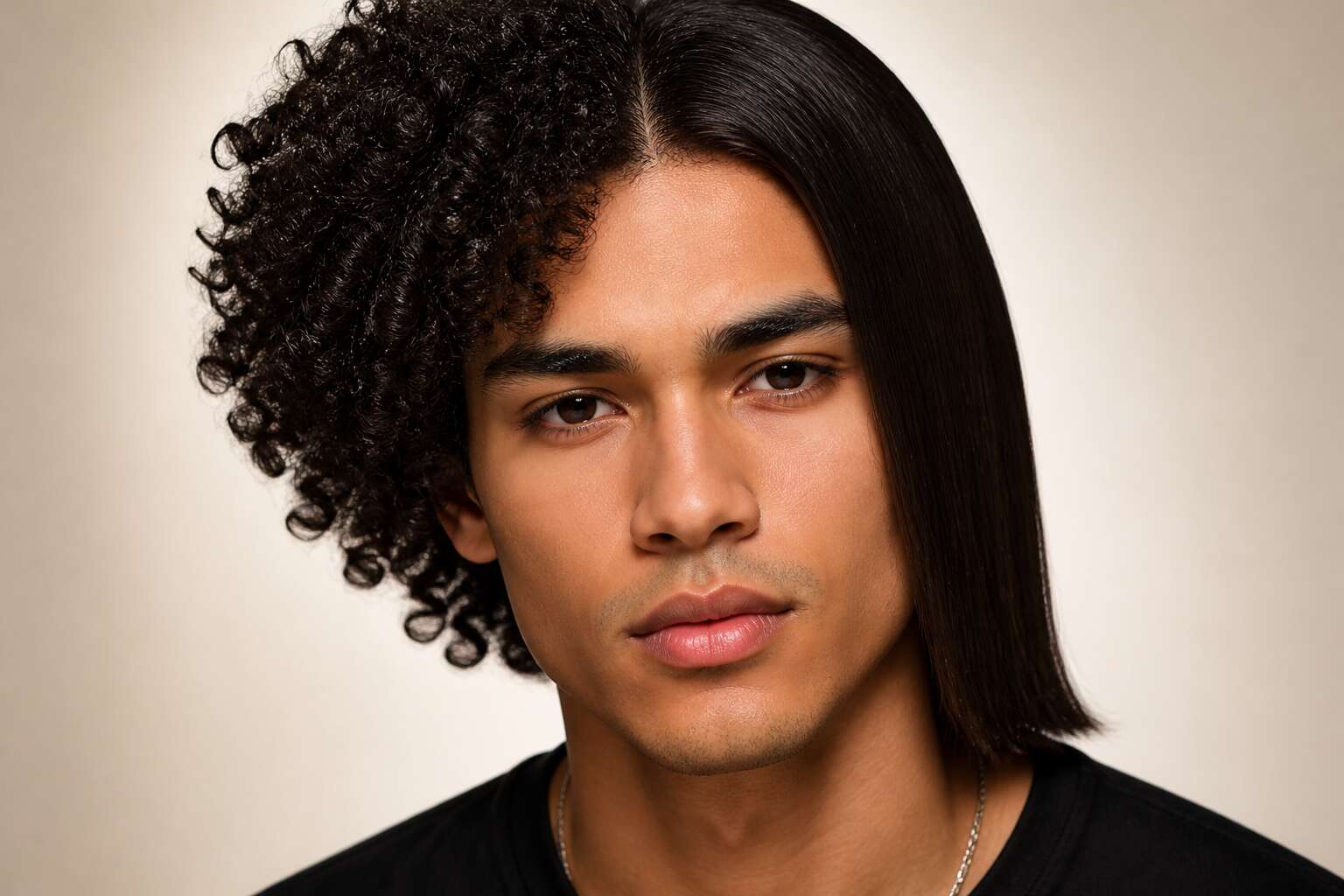
Understanding Curly Hair in Men
Why Men’s Curly Hair Behaves Differently
The follicle angle of a man’s curly hair determines a specific growth pattern. It is not a straight shoot from the scalp; it emerges at a sharp incline. This incline creates the helix, which resists the pull of gravity. In Johannesburg, that collar-line wave does not sit flat.
The hair shaft itself is elliptical in cross section. This shape weakens the cuticle, causing it to lift. In Durban’s humidity, absorbed water swells the shaft, resulting in shrinkage. On the dry highveld, loss of moisture leaves the hair brittle and frizzy. I have seen this confusion at my chair.
Understanding this behaviour is essential. The quest for curly hair to straight hair men begins with these physiological facts. The follicle’s tilt and the cortical bonds are built for coiling, not for lying flat.
Consider these factors:
- The follicle angle is oblique, not vertical.
- The cortex contains a different ratio of disulfide bonds.
- The cuticle is thicker and more prone to lifting.
These elements create a stubborn reality that any straightening process must overcome.
Hair Structure and Curl Patterns
The journey of curly hair to straight hair men is defined by geometry and protein bonds, not daily weather whims. A strand of curly hair is not a uniform cylinder. It is an elliptical, twisted ribbon. This shape forces the hair to buckle at regular intervals, creating that pronounced “S” pattern. Straight hair, by contrast, is a round tube that falls with gravity. The difference is stark when you inspect a single strand under professional magnification.
The cortex of curly hair holds the key to its rigidity. It is packed with a higher density of disulfide bonds, which are the chemical bridges that give hair its strength. These bonds are formed in clusters, pulling the structure into a tight curvature. For a man with a loose wavy pattern, the bond distribution is even. For tighter coils, the bond distribution is chaotic, creating numerous twists along a single hair shaft. This is why thermal tools fail so often. The heat rearranges the bonds temporarily, but the tension inside the strand constantly pulls the shape back to its original curl.
Achieving a lasting transformation requires addressing this internal architecture directly. It is a mechanical reaction inside the hair shaft that is broken and reset. Heat alone is a temporary fix. The structural realities are fixed while the hair is alive. Once you understand this friction, the choice becomes pragmatic.
– The hair shaft’s cross section is elliptical, not round.
– Disulfide bonds are distributed unevenly, creating curvature.
– The internal tension fights against the pull of gravity.
These factors dictate why a simple blow dryer session will not hold on a humid afternoon in Cape Town. The relaxation of these bonds requires a chemical shift that alters the protein structure permanently. This is the fundamental science behind the process of curly hair to straight hair men, and it involves a chemical restructuring of the hair’s core, not just the cuticle. It is a fragile balance between breaking those bonds and repairing the damage caused by the breaking.
Factors That Affect Curl Strength
Some men report that their curl pattern shifts over time, and this is not a trick of the light. As we age, the scalp produces less sebum, which alters the moisture balance of the hair shaft. Dehydrated strands contract and tighten, making a wavy head of hair look like a coiled mess by midday. This natural shift in oil production explains why a man’s hair can feel entirely different from one decade to the next. Hormones also play a role, as fluctuating androgen levels can shrink the hair follicle and change the angle at which the strand emerges. The result is a tighter, more stubborn curl that feels impossible to manage. Beyond biology, the environment in South Africa delivers its own punishment. Hard water deposits minerals onto the cuticle, which lifts the scales and allows moisture to escape. Once the cortex loses water, the disulfide bonds pack closer together, locking in a tighter shape. For men living in coastal cities like Durban, the humidity adds a layer of chaos, as hydrogen bonds constantly break and reform, pulling the strand back into its native loop. The friction from a cotton pillowcase, the pressure from a tight cap, and the daily ritual of aggressive towel drying all contribute to this structural fatigue. Any serious attempt at curly hair to straight hair men must account for these variables, or the process will fail before it truly begins. The factors are not random.
– The hydration level inside the hair shaft dictates curl elasticity.
– Hormonal changes over time alter the follicle shape.
– Environmental mineral build up weakens the cuticle’s integrity.
Each of these elements adjusts the bond tension inside the strand, which means the approach to straightening must be adapted to the individual. A man with thick, resilient curls has a different internal landscape than one with fine, fragile waves. The transformation demands a strategy that respects the current state of the hair, not a generic routine. For those pursuing curly hair to straight hair men, the condition of the scalp and the local water quality in Johannesburg or Pretoria will dictate how long any treatment holds. The chemistry is personal, and the results are directly tied to how well these factors are managed before the straightening process begins.
Realistic Expectations for Straightening
Straightening curly hair requires a sober appraisal of its limits. For men in South Africa, the climate and water chemistry mean results vary from week to week. Realistic expectations begin with understanding that curly hair to straight hair men is a temporary state, not a permanent identity. The curl returns as moisture and humidity rise.
I tell my clients that the strand’s original geometry remains intact. No treatment erases the follicle’s default. What straightening offers is a period of manageability, lasting three to five days.
Here is what determines longevity:
- The porosity of the hair cuticle
- The strength of the disulfide bonds
- The styling products used after the process
Each factor shifts with the season, a blowout in Cape Town may fail in Johannesburg. The goal for curly hair to straight hair men is to anticipate the curl, not to resist it.
Preparation Before Straightening
Assessing Your Hair Condition
Your hair’s resilience determines how safely it will transition from coil to straight. Before any heat touches your strands, a thorough evaluation of moisture levels and breakage patterns is non-negotiable for curly hair to straight hair men. Trust me, this step saves your hair.
Run a single strand between your fingers. If it snaps instantly, your cuticle is compromised. If it stretches and fails to return, elasticity is poor. Both conditions demand corrective treatment first.
Check these warning signs during your assessment:
- Rough texture along the shaft
- Excessive shedding during gentle combing
- Visible split ends at varying lengths
Address each issue with targeted conditioning masks or protein treatments. Only then should you proceed with any straightening method, ensuring the finished style remains sustainable.
Essential Tools and Products
Preparation before a single flat iron touches your scalp is not about patience, it is about physics. Heat styling is a controlled injury to the hair shaft, and the tools you choose determine whether that injury heals or worsens. For curly hair to straight hair men, the arsenal matters more than the technique.
The first layer of defense is a thermal protectant with silicone or keratin. Look for a spray or serum that lists heat protection up to 230 degrees Celsius. The second layer is the tool itself. Ceramic plates distribute heat evenly, while titanium heats faster but risks hot spots on coarse textures. A comb attachment is not a luxury, it is a necessity for tension control.
The essentials break down into three categories:
- Wide tooth comb for detangling wet hair, never a brush.
- Microfiber towel to absorb water without friction.
- Heat protectant spray with a fine mist nozzle for even coverage.
Conditioners sit in the background, but they are the unsung foundation. A leave in conditioner with hydrolyzed proteins rebuilds bonds during the process, not after. Skip any product with heavy oils, they fry under high heat and leave a dull film. The goal is a clean slate, so wash with a clarifying shampoo 24 hours before, then let the hair dry naturally to 80 percent. This sequence prevents moisture from turning into steam inside the strand, which causes bubbles and breakage. For curly hair to straight hair men, the prep phase is where the transformation is won or lost, long before the straightener clicks on.
Pre-Straightening Hair Care Routine
Preparation is about timing and discipline. For curly hair to straight hair men, the preamble determines the outcome.
A week before, apply a ceramide rich masque to strengthen the shaft, then rinse with cool water to seal the cuticle. Do not shampoo on the day of straightening. Spray a mist of water and aloe vera to rehydrate the strand’s flexibility. The hair must be dry to the touch but not brittle.
South African water hardness changes by city, so if your taps run chalky, finish with a pH balanced toner. Comb from the scalp outward, allowing the curl to loosen gradually. Never pull a wave taut from the tip; split ends reproduce that way.
Heat Protectants and Their Importance
The thermostat on a flat iron routinely reaches 230 degrees Celsius. For a man with dense, coiled hair, that heat is a weapon. The cuticle scales lift, the cortex loses its moisture, and the strand snaps. A heat protectant is the shield between your hair and that destruction.
Formulations with silicones, like dimethicone, coat each strand with a temporary film. This film disperses heat more evenly. Hydrolyzed proteins penetrate deeper, reinforcing the cortical structure before styling begins. The product you choose matters less than its coverage. Section the hair, spray, and distribute the protectant with a wide tooth comb to ensure every curl is armed.
Without this layer, the straightening process becomes a race between the iron and the damage it inflicts. Warmth should shape the strand, not scorch it. A good product raises the threshold for thermal damage, giving you more time to work and a smoother result.
For curly hair to straight hair men, a quality protectant is non-negotiable. It is the difference between a style that endures and a brittle, broken texture.
Patch Testing for Allergic Reactions
Allergic reactions to hair products are a real risk for anyone using chemical straighteners. Your scalp has thinner skin than your face, and it absorbs what you apply. A patch test takes five minutes and spares you a week of redness, itching, or swelling. For curly hair to straight hair men, the products involved carry stronger active ingredients, so your immune response deserves attention before the iron ever touches a strand.
- Apply a small amount of the straightening cream behind your ear.
- Leave it for the time stated on the packaging, usually 10 to 20 minutes.
- Rinse and wait 48 hours. Mild burning or a rash means you need a different formula.
Do this for every new product. Your curl pattern already demands careful management, and an allergic reaction only complicates the process. Allergens hide in fragrances, preservatives, and even emollients used in some lines. A clean test area gives you an honest reading.
Methods for Straightening Men’s Curly Hair
Using a Flat Iron Correctly
Flat irons work, but most men rush the process. For curly hair to straight hair men, the technique comes down to heat control and glide speed. Always start with completely dry hair. Set the iron to 190 degrees for finer strands and 210 for thicker ones. Never exceed this.
Work in small sections, about two centimetres wide. Clamp the iron once and slide from root to tip. One pass is enough. A wide toothed comb held ahead of the iron keeps strands aligned and prevents kinks. Pause at the ends for two seconds to seal the shape.
Allow each section to cool fully before moving on. This resets the bonds that lock in the straight result. In Durban’s coastal humidity, a slow cool down makes the difference between a smooth finish and a frizzy mess.
Blow Drying with a Round Brush
Blow drying with a round brush is an entirely different process from using a flat iron. For curly hair to straight hair men, this method relies on sustained tension and controlled airflow rather than direct plate contact.
Begin with freshly washed hair, towel dried and coated with a heat protectant. Section the hair into four quadrants. Take a ceramic round brush about four centimetres wide. Wrap a two centimetre section around the brush, hold it taut, and direct the dryer nozzle downward along the shaft. Keep the heat moving; never pause in one spot.
The brush must stay parallel to the strand’s angle. Lift slightly at the roots for volume, then glide to the ends. This takes longer than a flat iron, but the finished shape handles humidity better. I have used this technique on clients across Durban, and the curl memories stay dormant for days. For curly hair to straight hair men, that patience pays off.
Chemical Straightening Treatments
After all that effort with round brushes and precision airflow, an argument surfaces for permanence. Chemical straightening offers men a different relationship with their hair entirely. Instead of daily maintenance, the process works from within the hair shaft, dissolving the structural bonds that create curls.
Most relaxers use alkaline agents like sodium hydroxide or guanidine hydroxide. These compounds break the disulfide bonds that hold the curl pattern together. The hair is then neutralised in a straight state, often with a flat iron gliding through each section. For curly hair to straight hair men, this removes the need for a heated tool every morning.
Keratin treatments represent the gentler counterpart. They use formaldehyde derivatives to coat the strand and smooth the cuticle. Results last roughly three months, and the hair maintains some movement. A relaxer offers a more decisive change, but the alteration is permanent.
– Relaxers: Strongest chemical option, requires strict timing and professional application, permanently changes curl structure
– Keratin treatments: Semi-permanent coating, better for hair that needs flexibility, gradually fades after several weeks
The choice hinges on what your hair will accept. Fine hair demands milder formulations to prevent breakage. Thick, coarse curls can tolerate stronger products. Always cleanse with a neutralising shampoo afterwards to stop the process at the right moment.
Once the treatment is done, the care ritual shifts. Sulfate-free products are no longer optional, they protect the reshaped bonds. For curly hair to straight hair men, this pivot is worth understanding. The chemical path is not a shortcut. It requires patience, precision, and a commitment to the maintenance that follows.
Japanese and Keratin Straightening
Japanese straightening, often called thermal reconditioning, works strand by strand. A cysteamine solution softens the hair, then a flat iron locks it straight before the hair is rinsed and dried. The change is permanent, lasting until new roots appear. For men with tight, resistant curls, this method delivers a sleekness that no home routine can match!
Keratin straightening offers a softer timeline. The treatment saturates each strand with a protective protein blend, and the results fade gradually over months. I have watched clients in Johannesburg choose this route when they want smoother hair without losing all their texture.
The practical difference matters:
- Japanese straightening demands several hours in the chair and a skilled technician
- Keratin straightening takes less time and leaves room for styling freedom afterwards
For curly hair to straight hair men, both methods reshape your morning routine. The permanence of each is what separates them, and that is a personal calculation.
Temporary Straightening with Styling Products
Temporary straightening for men does not require a single heat tool or a salon appointment. Styling products can flatten curls for a few hours. Heavy creams and pomades with silicones coat the hair shaft, smoothing the cuticle and stretching the natural wave. The effect is modest but reliable. A man with tight ringlets can apply a generous amount to damp hair, comb it through, and let it air dry. The result is a sleeker silhouette that survives a short commute.
Here are the main product types for this job:
- Strong-hold pomade for coarse, resistant curls
- Silicone-based serum for fine hair that needs extra weight
- Styling cream with beeswax for medium hold and some flexibility
The trick is even distribution and patience. Touching the hair before it fully dries invites frizz and rebound. For curly hair to straight hair men, this approach offers a reversible option. It washes out with a single shampoo, making it ideal for a one-off event or a day when you want a change without a long-term commitment.
Combining Methods for Best Results
Why settle for a half measure when a layered approach can deliver a result that actually holds up through a full day? Combining methods is often the difference between a morning routine that works and one that collapses by lunch, especially for men with dense coils or stubborn waves. A garment steamer used on a low setting, for instance, can relax the curl pattern at the root before you ever touch a comb. This technique softens the follicle memory without baking moisture out of the strand, a common failure point for straightening attempts that rely solely on high heat.
The goal is to build a routine that layers technique in stages. You might pair a silicone-based styling cream with a low-temperature dryer and then finish with a cold shot of air to set the shaft. This sequence creates a smooth surface of cuticle while locking down the shape. For men who want a more permanent result, combining a keratin treatment with a flat iron over a few sessions will produce a more durable outcome than either method used alone. The chemical relaxes the bonds, and the heat sets the new form.
– Start with a cream-based product to control frizz before any heat is applied.
– Alternate between a wide-tooth comb for distributing product and a fine-tooth comb for final alignment.
– Finish with a lightweight serum only after the hair has fully cooled.
These steps make the process manageable. The trick is to avoid overworking the hair, which leads to breakage and a frizzy rebond. This entire strategy for curly hair to straight hair men is about order and timing, not brute force. Each stage supports the next, creating a smoother finish through subtraction of stress on the strands rather than constant manipulation, and the payoff is a style that feels natural for hours, not just for the first fifteen minutes after you leave the bathroom.
Maintaining Straight Hair After Styling
Daily Hair Care for Straightened Locks
Humidity in Johannesburg doesn’t care about your sleek blowout. Men who switch from curly hair to straight hair men often forget that maintenance is a daily battle. Every morning starts with a refresh, a wide-tooth comb, and a leave-in conditioner spray. Sleeping on satin reduces friction, so your hair stays flat overnight.
- Use a sulfate-free shampoo.
- Apply a heat protectant for touch-ups.
- Keep your flat iron under 180 degrees.
During the day, resist touching your hair. Your natural oils will resurrect the curl pattern faster than load shedding changes. Evenings are for repair, a lightweight oil on the ends and air drying completely. That’s the boring truth behind the glossy finish. Ignore this, and your curly hair to straight hair men journey turns into daily frustration.
Nighttime Protection to Prevent Re-Curling
Sleep is where most straightened styles fail. Your hair presses against cotton, absorbs its moisture, and the cuticle snags. That is how curls regroup. For any man on a curly hair to straight hair men journey, nighttime tactics decide whether your blowout survives till coffee.
Satin or silk pillowcases reduce that friction significantly. A loose pineapple ponytail, placed high on the crown, keeps straight lengths off the pillow entirely. Some men swear by a buff headwrap for extra security.
- A single drop of argan oil on the ends prevents overnight dryness.
- Fully dry hair is critical, any dampness invites the curl back.
- Tight elastics leave creases that survive the morning.
Morning refresh only needs a water mist and a tiny dab of leave in conditioner. No heat, no restyle. Protect it overnight and your straight hair stays obedient.
Refreshing Straight Hair Without Heat
Every straightened style is a temporary truce with humidity. Your hair remembers its natural curl and will attempt a coup before lunch. For men on a curly hair to straight hair men journey, the midday refresh determines whether you look intentional or disheveled.
Heat is the saboteur of that hard won straightness. A water mist and a pea sized dab of leave in conditioner revive the style without triggering frizz. You do not need a flat iron to fight the curl. You need to coax it back into submission.
The no heat refresh protocol:
- Mist the hair lightly, focusing on the ends.
- Work the conditioner through with flat palms.
- Smooth the strands downward, never scrunch.
- Let the hair settle for five minutes before touching it.
That routine keeps the straightness intact while the curl waits below the surface.
When to Schedule Touch-Up Sessions
Straight hair on a naturally curly head is a constructed state, a careful architecture that demands constant, diligent maintenance. The battle is not over once the last strand is cooled. The regrowth at your crown will announce itself within weeks, a stubbly, defiant reminder of the curl’s permanence.
The interval before your next scheduled service is a precise calculation. For men using a flat iron or keratin treatments, a four to eight week cycle is the standard. After eight weeks, the demarcation line becomes stark, and the juxtaposition of a kinky root against a poker-straight shaft makes the style look neglected.
A well-maintained style requires both daily discipline and a planned retreat. The decision to revisit your stylist depends on your hair’s growth rate and the seasonal humidity in South Africa. In a coastal climate, the regrowth may be less visible, but the frizz will return quicker, signaling the need for a touch-up.
– Week 4: Assess root volume. If a tuft of springy curl emerges, book your session.
– Week 6: A standard interval for chemical treatments. The bond is still strong, but a rebase is practical.
– Week 8: The absolute maximum wait. Beyond this, the reversion process accelerates, making the next straightening session longer and more stressful on your hair.
There is also a strategic option to let the style fade out naturally. Cutting the hair shorter over time, rather than re-straightening the regrowth, allows the curly hair to straight hair men transition to occur gracefully. This approach avoids the harsh breakage that comes from overlapping chemicals on the previously treated ends.
Nourishing Oils and Serums for Shine
Straightened hair loses its natural lipid barrier, leaving the shaft exposed to humidity and friction. A nourishing oil or serum restores that glossy boundary. For men who have made the leap, the right product acts as a sealant, locking in the smooth silhouette that took hours to achieve.
Choose a serum with cyclopentasiloxane for a featherlight coat, or a cold-pressed marula oil for deeper sheen. The standard method involves warming a few drops in the palms, then pressing them down the hair’s length while avoiding the scalp entirely. This technique prevents the dreaded greasy root.
- Argan oil for lightweight reflection
- Camellia oil for a glass-like finish
- Jojoba serum for a matte, natural glow
Morning applications, kept sparse, maintain the gloss without buildup. The goal is visual polish, not rehydration. Curly hair to straight hair men requires a shift in mindset: oils are accessories, not treatments.
Common Mistakes and Troubleshooting
Overheating and Heat Damage Risks
Heat damage creeps in silently. Men attempting curly hair to straight hair men often trust the iron’s dial without questioning its cruelty. A common mistake is treating every curl like a straight strand, pressing down with force and dragging the tool across the same patch of hair repeatedly. That friction, combined with high temperature, fractures the cuticle before you ever see the shine.
Troubleshooting begins with your senses. If you hear a hiss or smell something like burnt sugar, stop immediately. Lower the heat and check the plate’s glide. Another frequent error is skipping a heat protectant because it feels like an extra step. For curly hair to straight hair men, protection is not optional.
- Never exceed 190°C on fine curls.
- Test a hidden strand before the full pass.
- Do not clamp too tightly or slide for more than two seconds.
A damaged curl cannot be revived, only grown out. Respect the moisture in your hair and the silence between passes.
Why Your Hair Won’t Stay Straight
Few things defeat a man faster than watching straightened curls revert by lunchtime in Durban. For men attempting curly hair to straight hair men, the failure to hold a style is rarely the flat iron’s fault. It is moisture. Hair retains its original shape, and humidity triggers reversion.
Most reverting hair comes down to a few mistakes:
- Product buildup that attracts moisture and weighs strands down
- Hair that was not completely dry before the iron passed over it
- Moving the head while the strand is still warm, bending the shape back into a curve
That last mistake catches almost everyone! You straighten a section, turn to check the mirror, and the strand folds while warm. The curl resets itself. For curly hair to straight hair men, the real adversary is the hair’s built-in curl pattern, not the heat.
Frizz and Humidity Challenges
Most men assume humidity makes curly hair to straight hair men revert, but the real issue is often a rushed cooling phase. Move your head too soon and the strand folds while warm, resetting the curl. Another frequent error is skipping a final cool shot with the hairdryer, which locks in the straight shape.
Frizz appears when the cuticle lifts. This happens for three reasons!
- Using a towel to rub wet hair, roughing up the cuticle
- Applying product to hair that is still damp beneath the surface
- Stepping outside without a humidity barrier, such as a light serum
In Durban’s coastal air, I have watched well-straightened hair absorb ambient moisture rapidly. The mirror reveals nothing useful until the strand cools fully. For curly hair to straight hair men, a lower heat final pass proves more effective than a second high-heat run.
Dealing with Uneven Straightening
Uneven straightening betrays effort. For curly hair to straight hair men, the problem rarely lies in the product. It hides in the sectioning. Leave one side thicker and the heat cannot penetrate equally. The strand relapses hours later.
- Uneven section sizes, thick on one side and thin on the other.
- A rushed pass that leaves the inner core unheated.
- Ignoring the underside until the top appears perfect.
I have watched men straighten the crown obsessively while the nape stays curly. A mirror check from the side catches this. The residual kinks in the lower layers are the real culprit in Durban’s coastal humidity.
Recovering from a Bad Straightening Job
Few things test a man’s patience like a bad straightening job. You spent an hour in front of the mirror, and the result still looks wrong. For curly hair to straight hair men, recovery demands more patience than the initial attempt. Rushing to reheat damaged sections compounds the problem. The cuticle is stressed, moisture is stripped, and the bonds are barely holding. I have watched men grab the flat iron again in frustration. That is the wrong move!
Assess what failed before touching the hair again:
- Was the hair completely dry before the iron touched it?
- Did the heat protectant match the temperature setting?
- Is the hair over-processed from chemical treatments?
Sometimes the hair needs a break. For curly hair to straight hair men, a lightweight conditioner and a day of rest often fix what another pass with heat will ruin. In Johannesburg’s dry winter air, a bad job reveals itself within hours.


0 Comments