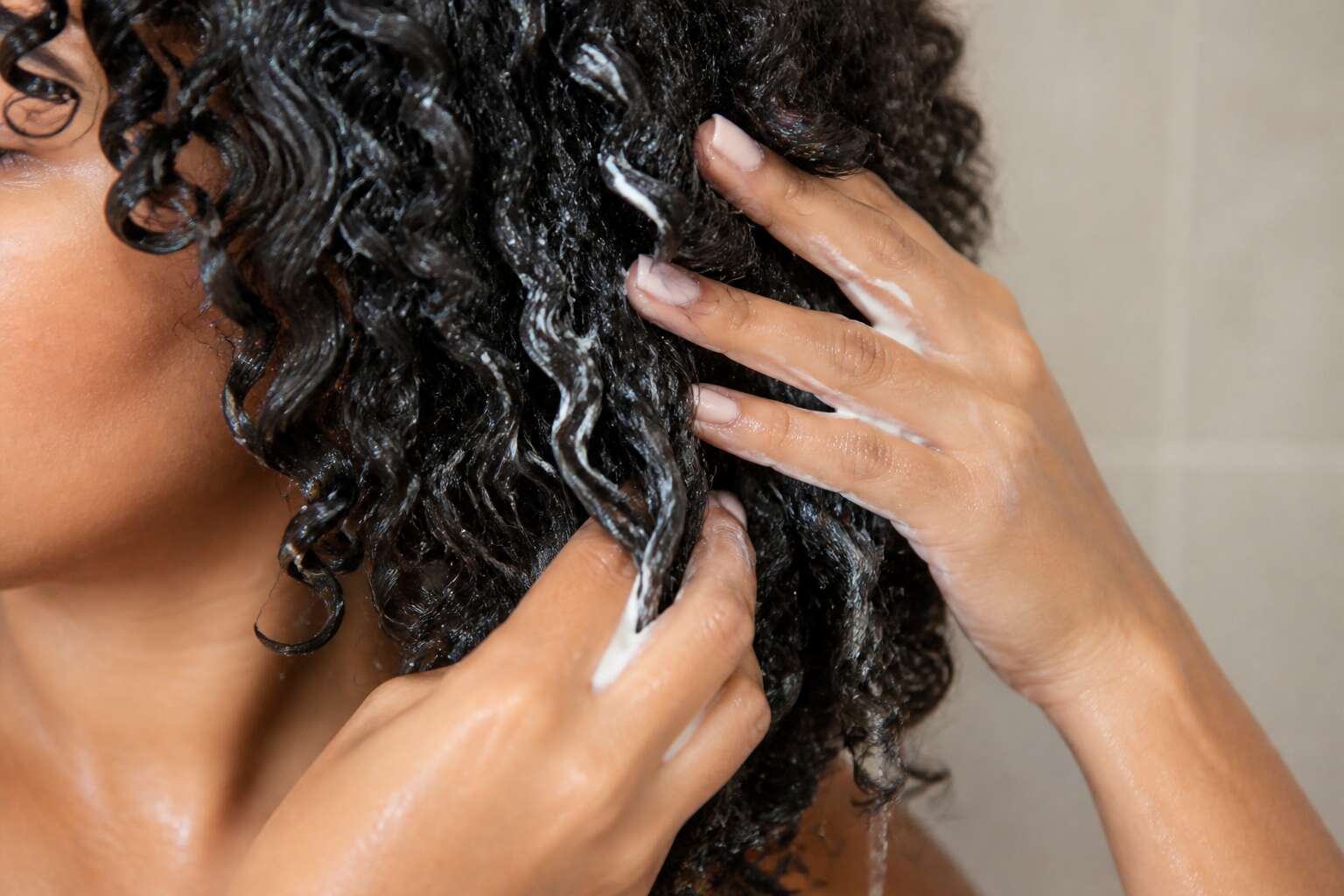
Understanding Curly Hair Moisture Needs
Why Curls Require Extra Hydration
Curly hair loses moisture at a rate that straight hair never approaches. The cuticle scales lift along the curve of the strand, creating gaps where water escapes into the dry air. Sebum, the scalp’s own conditioner, cannot migrate down a coiled shaft, leaving the ends to fend for themselves. This is structural truth, not a styling preference.
- Heat styling raises the cuticle and hastens evaporation.
- Sulfate cleansers leach the lipids that hold water inside the cortex.
- Hard water deposits minerals that block hydration from entering.
A dedicated conditioner curly hair routine must do more than soften. It should deliver humectants and emollients directly into the porous gaps. For South African summers, humidity and heat pull moisture from the strand by noon. In my experience, a thoughtful conditioner curly hair stabilises the hair’s hydro balance so the weather cannot dictate your curl’s fate.
The Science of the Curl Structure
In South Africa, the humidity does not negotiate. It arrives in late spring, a warm, wet presence that can turn a defined curl into a fog of frizz by mid-morning. Yet the opposite holds true in the dry Highveld winters, where the air sucks every drop of available moisture from the strand, leaving a brittle, straw-like texture. This constant change in atmospheric pressure means a single product is often asked to perform contradictory roles. The intelligence here is not in fighting the environment, but in choosing a conditioner curly hair that works with the seasons.
Understanding the moisture needs of a curl is an exercise in measured observation. When the air is heavy, the hair’s porosity works against you, absorbing ambient water and lifting the cuticle. In a dry climate, that same porosity allows vital moisture to escape. A thoughtful regime looks to balance this. The answer is not always to add more, but to hold onto what you have. A conditioner curly hair designed for this climate acts as a mediator, managing the tension between the hair’s internal water and the external air.
The intelligent approach to curl management relies on understanding this interplay between the strand and the elements. Consider the following methods to achieve this balance:
– A formula with lighter emollients that coat without weighing down the pattern.
– Regular application to maintain a consistent hydration baseline.
– Observation of how the hair reacts to sudden weather shifts.
Curls require a degree of patience and a resistance to quick fixes. The structure of the strand itself presents a challenge, one that demands a response from the products you choose. Rather than seeking a single, permanent solution, the goal is to maintain a steady state. The most effective conditioner curly hair provides what the atmosphere withholds. It offers a defined, controlled response to the chaos of the elements, allowing the natural pattern to express itself with confidence in any weather. The goal is quiet harmony, not forced conformity.
Common Conditioning Mistakes That Worsen Frizz
Moisture is not hydration! Your curls can feel wet yet remain parched at the cuticle, and porosity decides how much water actually stays put. In Johannesburg’s dry winter, the right conditioner curly hair should seal, not merely soak.
Over-conditioning is the first common mistake. That squeaky-clean feeling is actually a warning. You have over-saturated the strand, and now it rejects further moisture. Rinsing too quickly is the second mistake, washing away the ingredients your curls need. The third is applying product to sopping wet hair, which dilutes everything before it can work. I have watched women do all three in a single wash day.
- A conditioner curly hair with humectants suits humid Durban days.
- Heavier butters work better when the Cape winter wind arrives.
Recognizing Dehydration vs. Protein Overload
“A curl that snaps is not asking for more moisture. It is asking for a different kind of respect,” says a texture specialist from Cape Town, a city where the South Easter tests every hair type. The distinction between a thirsty curl and a broken one is subtle, but getting it wrong means reaching for the wrong conditioner curly hair and watching your pattern collapse.
When a strand lacks hydration, it feels rough and appears dull before you wash it. Yet after you apply a rich cream, the curl supplely bounces back within minutes. This is dehydration. The cuticle is raised and ruffled, allowing water to escape as quickly as it enters. Inland regions with Karoo winds strip the strand constantly, leaving it dry silky to the touch, but not brittle.
Protein overload acts differently. The hair feels hard and stiff even while it is soaking wet. Your strand might smell a little sour and it will stretch strangely before breaking off with a sharp snap. The hair has too much structure and not enough flexibility.
The challenge is that modern labels confuse this further. A product with keratin claims repair, but you might actually need softness. A deep treatment loaded with botanical oils might be perfect, but only if your hair is truly thirsty and not over-stiffened.
| Old Kruger cattle | Grazing in a winter field |
| Their hides are thick | Yet their bones show through |
Consider the water in Durban. The humid air hydrates the hair shaft from the outside, which can mask an internal deficiency that only emerges when you travel to the Highveld. In Johannesburg, the air is so dry that a true protein overload will feel like straw. You must read the strand like a farmer reads the sky. If it splits but retains curl memory, it is thirsty. If it crumbles without bending, it is overbuilt.
A good rule involves looking at your wash day. If your hair feels better after you skip the heavy treatments and just use a light daily formula, you have protein buildup. If it feels better after a butter-heavy mask under a heat cap, you have dehydration. Using the wrong conditioner curly hair on either state amplifies the problem, turning a simple maintenance task into a cycle of breakage.
The Role of the Hair Cuticle in Water Retention
The cuticle is a series of overlapping scales that control water exchange. When these scales lie flat, the strand holds moisture. When they lift, water escapes as quickly as it enters. Curly hair has a larger surface area, which means more cuticle exposure and more water loss.
Porosity determines how much water a strand can keep. High porosity hair loses water fast. Low porosity hair resists water entry entirely. Both conditions require a conditioner curly hair that works with the cuticle, not against it.
- Humidity in coastal cities like Durban changes how much water the cuticle absorbs
- Heat styling damages the cuticle’s ability to close
- Hard water leaves mineral deposits that block water retention
A well matched conditioner curly hair helps the cuticle seal and keeps the cortex hydrated between wash days.
Key Ingredients to Prioritize in Your Conditioner
Humectants for Attracting and Retaining Moisture
Humectants are the unsung heroes in the dry South African climate. They work by pulling water from the air and deeper layers of the skin into the hair shaft. The result is a plump, supple strand that resists snapping. For those battling brittle ends in the Highveld’s thin air, these ingredients are not a luxury but a necessity. They form the very backbone of an effective regimen, ensuring every drop of water counts.
A quality product will feature specific molecules designed for this task. When you read the label of your conditioner curly hair, look for these key players:
– Glycerin, a classic and reliable choice for drawing in ambient moisture.
– Propylene glycol, which works well in various humidity levels to keep the balance.
– Sodium PCA, a more sophisticated option that mimics the hair’s natural moisturising factors.
These agents excel at holding water within the cortex, where it is needed most. However, their effectiveness hinges on the environment. In Cape Town’s coastal humidity, a lighter humectant is preferable. In Johannesburg’s dry winters, you might need a heavier blend to prevent moisture from being pulled out of the hair rather than into it. This balance is the crux of effective hydration. The true skill lies in matching the humectant to your specific surroundings to maintain that coveted softness and elasticity.
Emollients and Oils That Soften and Smooth
Humectants are only half the story, of course. The other half lies in the occlusive and restorative power of oils. In the relentless South African sun, water drawn into the strand is precious and needs a seal. A high quality conditioner curly hair uses botanical oils to laminate the cuticle, locking the hydration inside and repelling the dry air that seeks to steal it away.
The choice of oil dictates the finish. A lightweight oil will define and separate, while a richer butter will provide deep, sink-in nutrition. Consider the following pairings in your next formulation:
1. Argan oil for a fast-absorbing, silky finish that tames the outer layer.
2. Shea butter for raw, unctuous nourishment that targets the coarsest textures.
3. Jojoba esters which mimic the scalp’s own sebum for a balanced, non-greasy feel.
These emollients fill the gaps along the hair shaft, creating an even, smooth surface that reflects light and resists tangling. The distinction lies in the viscosity; a fine oil for the fine-haired, a denser oil for the kinky and coiled. The best conditioner curly hair options will list the oil that matches your porosity, ensuring the softness you feel comes from authentic repair, not temporary coating. It is the final, silken glove that turns a brittle mane into a supple curtain.
Hydrolyzed Proteins for Strength and Elasticity
Every strand of curly hair carries stress points that straight hair never experiences. Hydrolyzed proteins are small enough to pass through the cuticle into the cortex, the region where breakage actually begins. For coiled textures, protein loss is a gradual decay. Heat exposure and mechanical tension sever the peptide bonds that give strands their elasticity.
Choose a conditioner curly hair that specifies its protein sources:
- Hydrolyzed keratin, which mirrors the hair’s native structure.
- Hydrolyzed silk for a finer molecular weight and deeper reach.
- Hydrolyzed wheat for flexible, cushioning reinforcement.
An excess leaves the strand brittle and rigid. A measured amount restores the give that prevents snapping. The best conditioner curly hair pairs these proteins with the emollients already discussed, so strength and softness arrive as one. Resilience is the result.
Butters and Natural Extracts for Deep Nourishment
In South Africa, where the sun strips moisture with a vengeance, one in three curly-haired women reports that their conditioner vanishes before the week ends. The culprit is often a formula lacking true butters, those dense, unctuous bases that act as anchors for every other ingredient.
Conditioner curly hair demands more than water and slip. It thrives on unrefined shea butter, which carries a dense fatty acid profile perfect for porous strands. Mango butter serves finer coils with a lighter touch, while cocoa butter offers a firmer hold for high-density textures. For botanical depth, consider these extracts:
- Rooibos, harvested only in the Cederberg, provides antioxidants that calm a sun-stressed scalp.
- Aloe vera, a polysaccharide film that binds moisture to the strand.
- Hibiscus, which adds slip and gently smooths the cuticle.
Butters and extracts work together, one sealing while the other feeds. When you choose a conditioner curly hair that lists these ingredients early in the formulation, you are reading a promise of longevity and softness, not just a label.
Ingredients to Avoid for Healthier Curls
Summer in Johannesburg leaves curls dehydrated and brittle. A proper conditioner curly hair must carry ceramides, the lipid molecules that repair the cuticle after a season of sun and chlorine. Panthenol sinks into the cortex and holds water without weighing coils down. South African water runs hard, so a chelating agent such as EDTA removes the mineral film that dulls the hair. These ingredients belong near the top of the list, where they are concentrated enough to act.
Other ingredients are hostile to the strand. Avoid them:
– Sodium lauryl sulfate, which strips the scalp and forces curls to fend for themselves.
– Isopropyl alcohol, which dries the hair from within.
– Non-soluble silicones, which seal the outside while leaving the inside empty.
The right conditioner curly hair names its enemies on the label. The hair will remember the difference.
Understanding the Ingredients-to-Avoid Label Watch
Never trust a conditioner that buries its heroes at the bottom of the ingredient list. That is where the cheap fillers live, and your curls can smell the difference. A study found that many mass market conditioners contain less than 1% of their advertised active ingredients. The label promises miracles, but the formula delivers water and perfume.
Choose a product where the active ingredients are concentrated enough to do work. Here is what you want to see in the top five slots:
– Ceramides; they rebuild the lipid layer that sun and chlorine erode.
– Panthenol; it holds water in the cortex without flattening the curl pattern.
– EDTA or another chelator; it removes the mineral film left by hard water.
A conditioner curly hair routine requires a product that attacks the problem at the source. Johannesburg water is notoriously hard, so the calcium and magnesium deposits need a solvent. Without a chelator, heavy conditioners coat the hair in wax, making it feel soft but preventing water from entering. The result is a strand that looks damp and feels dry.
Proteins and silicones are not villains, but only when used with intention. The conditioner curly hair formulas that work best have a record of solubility. They wash out cleanly or break down gradually. If the ingredient is a plastic that coats the cuticle, the cortex starves. The product sits on the surface, creating a mirage of moisture that shatters at the first sign of humidity. That is how frizz appears within hours of a wash day. Pick the formula that respects the strand.
How to Apply Conditioner for Maximum Curl Benefits
The Squish-to-Condition Technique Explained
Few people realise that the pressing motion of standard conditioner application works against the cuticle. The squish to condish technique reverses this, compressing the hair to pull water and conditioner deep inside. For your conditioner curly hair, this one change can reduce frizz noticeably.
- Apply conditioner to soaking wet, detangled hair.
- Cup a section in your palms and squish upward for ten seconds.
- Add a teaspoon of water and squish again until the hair feels slippery.
The extra water is critical. It dilutes the conditioner just enough to let the cuticle swell and accept moisture. Skipping this leaves your curls coated, not hydrated.
Deep Conditioning Rituals for Weekly Restoration
Deep conditioning amounts to a sacred ceremony for curls, one that rewards patience above all haste. Your strands, after a week of exposure to the Highveld’s unforgiving sun or the coastal humidity, crave a return to their inherent suppleness. A weekly ritual of profound nourishment, performed with deliberate focus, rebuilds the very architecture of each coil, ensuring they spring back with resilience instead of drooping into fatigue. This is where your chosen conditioner curly hair truly earns its restorative reputation.
This process extends beyond simple hydration, reaching into the cortex to replenish the structural components that styling and daily manipulation leach away. The right formulation, allowed to permeate under gentle heat, restores a pliability that mirrors freshly nourished hair. Consider this your atonement for the week’s thermal styling and environmental stressors.
– To commence, apply a generous amount of your deep conditioner to freshly cleansed, still damp hair.
– Then, cover your mane with a thermal cap or a warm, damp towel to open the cuticle and amplify penetration.
– Finally, allow this luxurious masque to rest for a minimum of twenty uninterrupted minutes, letting the science of absorption do its silent work.
The reward is a supple elasticity that defines the curl pattern without the burden of heavy residue. This weekly devotion uses your conditioner curly hair as a tool for restoration, not just maintenance. The intensive delivery of lipids and hydrolyzed nutrients fortifies the keratin matrix, so your curls feel substantial and defined from root to tip, holding their shape through any atmosphere the country throws at them.
Co-Washing vs. Traditional Conditioning Methods
A single coil absorbs product differently depending on how your fingers move. Pressing conditioner curl by curl invites a deeper uptake than raking it through blindly. Your conditioner curly hair requires this deliberate touch, especially when choosing between washing methods.
Co-washing replaces shampoo with a cleansing conditioner, preserving the natural lipid barrier. Traditional conditioning starts with stripping shampoo, then rebuilding moisture. Both work, but the results diverge:
- Co-washing suits dense or dry curls, offering daily hydration without lather.
- Traditional methods provide a fresh slate for lighter, finer spiral textures.
Apply the conditioner to soaking strands, then squelch gently. The cuticle yields its defenses, and the curl springs into its destined shape.
Determining the Right Frequency for Your Curls
Research suggests the average person spends over a year of their life applying hair products. For those with textured hair, that time is an investment in identity. The method of application determines whether that product works for you or merely sits on the surface.
Think of water as the vehicle for your conditioner curly hair ritual. On soaking wet strands, the cuticle is lifted and receptive. Work the product into your palms and press them over the length of your hair, never scrubbing. This pressing motion encourages the conditioner to penetrate the cortex, locking in the hydration that brushing would strip away.
Frequency is not a universal number. It is a dialogue with your own hair’s needs.
– High porosity hair absorbs moisture quickly but loses it just as fast, requiring daily or every other day conditioning.
– Low porosity hair retains moisture but struggles to accept it, so a lighter application every three to four days prevents buildup.
– Dense or coarse textures benefit from more frequent sessions, while fine spirals may feel weighed down by repeat use.
Listen to that specific conversation. The Cape humidity alters the equation, a factor that turns a Tuesday wash day into a meditation. Your conditioner curly hair practice should remain fluid, shifting with the weather and the season. The goal is a curl that springs with intention, not one that is forced into a shape it never wanted. That resilience is the quiet reward of attention, a small triumph over the chaos of the environment and the stray chromosome that gave you that beautiful, stubborn coil.
Layering Conditioner with Leave-In Products
Application begins with the palm press, not the scrubbing motion. Wet curls open their cuticles; that vulnerable state is when your conditioner curly hair needs the gentlest touch. Slide the product between your palms and press it over each section, letting the weight of your hands do the work. For thicker density, repeat this press twice, but for fine spirals, one pass is enough to avoid residue buildup.
Layering a leave-in after rinsing is the separation of duties. The rinse out conditioner delivers the moisture, while the leave-in seals the boundary. A pea sized amount of leave-in, emulsified with water, locks the hydration into the cortex without disrupting the curl pattern.
- Press conditioner into soaking wet hair section by section.
- Rinse with cool water to close the cuticle.
- Apply leave-in to damp hair with palms pressed flat.
This sequence respects the hair’s natural porosity and the Cape humidity that reshapes every curl’s expectations. The result is a hold that lasts without stiffness.
Using Heat Caps and Steamers to Boost Absorption
Most curly hair routines stall at the application stage. You massage conditioner curly hair into the strands, let it sit for five minutes, and rinse. The moisture never truly penetrates. Heat changes that equation. When your hair is exposed to warmth, the cuticle lifts more consistently, allowing the conditioning agents to move deeper into the cortex. A steam cap or steamer works with the hair’s natural biology rather than against it.
The process is simple enough for a Sunday afternoon. Apply your conditioner curly hair product generously, then cover with a plastic cap. A warm towel or a heated cap will do. The goal is sustained, gentle heat, not scorching. Steaming takes this a step further by introducing vapor directly to the hair shaft.
Consider this method if your curls feel dry an hour after conditioning:
– Start with clean, soaking wet hair.
– Section the hair into four parts.
– Apply your conditioner heavily to each section.
– Cover with the cap and apply heat for twenty minutes.
– Rinse with cool water to lock in the benefit.
The South African climate, with its dry winters and punishing summers, strips moisture fast. A steamer gives your product a fighting chance. The extra cost is justified by the difference in elasticity and shine. Your curls will feel different the moment you rinse, and the effect lasts past the next wash day. No complicated tools are required, just a little patience and the right approach to conditioner curly hair. The time investment pays off in fewer breakouts and less frizz.
Matching the Right Conditioner to Your Curl Type
Lightweight Formulas for Loose Waves (2A-2C)
Loose waves, classified between 2A and 2C, occupy a curious middle ground. Their S-shaped bends rarely extend from root to tip, so gravity pulls them downward more noticeably. A conditioner curly hair formula that serves a tight coil can flatten these delicate arcs within hours.
The distinguishing factor is molecular weight. Lightweight cationic surfactants and low viscosity esters coat the strand without accumulation. In Johannesburg’s harder water or Durban’s coastal humidity, I have found that a conditioner curly hair product built on water as the primary solvent outperforms anything dependent on heavy seed oils.
Formulas that suit this pattern share certain markers:
- Transparent or milky consistency instead of opaque creams
- Glycerin listed before any oil in the ingredient sequence
- No petrolatum or mineral oil derivatives
Frequent, modest hydration preserves the bend better than occasional heavy masks. The cuticle stays flat, the strand holds water, and the wave keeps its arc.
Balanced Moisture for Classic Curls (3A-3C)
Classic curls in the 3A to 3C range demand a different kind of commitment. These spirals have distinct, springy coils that need substantial moisture to prevent that familiar frizz. Using the wrong conditioner curly hair can leave the strands looking brittle or, conversely, weighed down into lank ropes. The balance is quite particular.
I have seen many clients in Cape Town struggle with products that promise hydration but deliver only surface shine. The true goal is to replenish the cortex, the inner structure of the hair, without coating the exterior so much that the curl loses its form. A richer formula is needed here, one that offers both slip and strength.
For these curlier patterns, heavier ingredients become necessary, but their application must be precise. Look for specific markers in a product to gauge its suitability:
– A creamy, opaque texture that visibly coats the hair.
– Oils like shea or jojoba appearing within the first five ingredients.
– The absence of drying sulfates, which strip the natural oils faster.
The challenge is to find a conditioner curly hair that delivers intense nourishment yet allows the coil to snap back. Water is still vital, and a good product will include humectants alongside those richer oils. In Johannesburg’s dry winter air, this combination helps to keep the hair supple, while in Durban’s humidity, it provides a barrier without the dreaded crunch. The texture of these curls means that hydration needs to travel deeper, and a heavier conditioner acts as that vehicle, smoothing the cuticle and allowing the natural curl pattern to fully express itself.
Rich Creams for Coily and Kinky Textures (4A-4C)
In the realm of type 4 curls, the rules shift entirely. Where springy coils demand balance, coily and kinky textures cry out for saturation. The density of these strands can make them look and feel dry even after a thorough rinse. I have seen how a light touch fails these patterns. The hair needs a thick, rich conditioner curly hair formula that will physically hold the strands together. This is not about achieving balance but about providing a deep, lasting soak. The goal is to mimic the natural sebum that struggles to travel down these twisted lengths.
Choosing the right product for 4A through 4C patterns means embracing a heavier hand. The texture should feel like a smooth butter or a dense cream. A quality conditioner curly hair product for this group will leave a discernible film on the hair, which is a necessary shield against extreme humidity and dry winds.
When I select products for this hair type, I look for a few foundational traits:
1. A base of shea butter or mango butter listed near the top of the ingredients.
2. The presence of thick emollients like castor oil or avocado oil.
3. A texture that does not melt immediately upon contact with the skin.
4. No protein in the first five components, as strength must come from moisture first.
The hydration here must travel the full length of the coil. A watery gel will evaporate too fast in the Johannesburg sun. A robust, creamy conditioner creates a moisture reservoir that the hair can pull from for days. In Durban’s heavy air, this same product prevents the hair from absorbing excess water and shrinking into a tight, unmanageable mass. The true test is how the hair feels the following morning. It should still feel supple and soft to the touch, not hard or coated. That is the signature of a conditioner curly hair product that understands the specific demands of kinky textures.
Factoring in Hair Porosity and Density
Porosity and density often override curl type when choosing a conditioner. A low porosity 3A curl repels water, while a high porosity 4C strand drinks it fast. Your conditioner curly hair choice must answer both realities. I test this by dropping a strand into a glass of water. Floating means low porosity, sinking means high. Dense, low porosity hair needs a light conditioner with humectants. Sparse, high porosity hair needs a heavier cream. Here is what I check before recommending any product:
- The strand’s behaviour after soaking
- How quickly the hair dries
- The feel of the hair when wet and when dry
That routine tells me whether your product should be a thin milk or a thick butter. Porosity dictates absorption, density dictates weight. Match both, and the curl responds!
Adapting Your Choice Based on Season and Humidity
The Cape Town summer flips the script on your carefully curated routine. That rich conditioner curly hair loves in July becomes a liability when the berg wind blows and humidity vanishes. Your hair suddenly feels like straw, despite using the same product that carried you through winter. This is where seasonal editing saves your sanity.
Humidity changes how your conditioner behaves. High summer humidity means your hair swells with moisture from the air alone. Use a heavier formula and you are begging for frizz. Conversely, dry winter air strips water from the strand, so a light milk splits under pressure. The fix is routine, not permanent.
1. Swap your heavy cream for a lighter lotion when humidity climbs above sixty percent.
2. Move to richer formulations when the air turns dry and the strand feels brittle.
3. Keep a small spray bottle with diluted conditioner curly hair for adjustment days.
The same curl pattern behaves differently in Durban’s sticky air versus Joburg’s dry highveld. Your porosity stays constant, but the environment changes how fast your hair loses water. A low porosity curl in Johannesburg needs more slip to absorb product. A high porosity curl in the Cape needs weight to seal fast. Adjust the product density and you keep the definition without pudding-like buildup.
Building a Complete Curly Hair Care Routine
Pairing Shampoo and Conditioner for Synergy
Pairing your shampoo with a matching conditioner curly hair system can transform your routine. A harsh shampoo strips the scalp, while a lightweight conditioner fails to seal the cuticle. The result is frizz that no amount of styling can fix.
Think of the wash day as a single conversation. The shampoo sets the pH, and the conditioner closes the barrier. For synergy, choose products that share a common ingredient base. That way, the cleanser preps the strand without working against the moisturiser.
- Match your shampoo’s protein level to your conditioner’s emollient weight.
- Test the pair on a single section before committing.
- Adjust based on water hardness in your area.
South African water varies, so your pairing must adapt. A conditioner curly hair routine only works when both steps cooperate.
Integrating Leave-In Conditioners and Curl Creams
South African humidity doesn’t negotiate. One morning your curls hold their shape, the next they expand into a cloud. This volatility demands a routine with more than a single hero product. A leave-in conditioner curly hair requires a partner to lock in the work. Curl creams seal the moisture that leave-ins deliver, provided you apply them in the correct order.
The application sequence matters as much as the formulas. Work the leave-in through soaking wet hair first. This is the layer that penetrates the cortex and draws water into the strand. Follow with a dime sized amount of curl cream, smoothed over the surface to form a protective coating. The cream prevents environmental moisture from triggering swelling while locking the leave-in inside the hair shaft.
Consider the product weights. A lightweight leave-in formula with humectants suits low porosity strands. High porosity hair needs a richer cream with shea butter to slow water loss. Apply in sections to ensure even distribution:
1. Split hair into four quadrants.
2. Apply leave-in to the mid lengths first, then the ends.
3. Glaze the cream over the same section.
4. Scrunch upward toward the scalp to encourage curl formation.
The mistake most people make is stacking products haphazardly. A heavy cream over a rich leave-in leaves a greasy film. A watery leave-in under a light cream evaporates before midday. Listen to what the strand tells you. If the curl looks defined but feels sticky, skip the cream for a day. If it feels rough by afternoon, add more leave-in next wash day.
The water you wash with in Johannesburg, Durban, or Cape Town changes the outcome. Hard water leaves mineral deposits that block product absorption. A chelating shampoo once every few weeks clears the way. Your conditioner curly hair products will perform more consistently when the strand starts clean. The combination of a proper base, a hydrating leave-in, and a sealing cream creates a reproducible result, no matter what the sky does.
Refreshing Curls Between Wash Days
The second day after wash day is when a curl’s true character emerges. Refreshing curls between wash days is less about rebuilding and more about revival. A spray bottle filled with water and a pea sized dab of conditioner curly hair products can coax a flattened style back into its original architecture. The key is to mist the hair evenly, then use your palms to smooth down the frizz without breaking the cast.
Focus on the canopy first. This area experiences the most friction from pillows and scarves. The under layers usually retain enough hydration and need minimal attention. A diluted leave in formula works better for this purpose than a thick cream. The latter will simply sit on the surface and attract lint.
The process itself takes under five minutes:
1. Lightly mist the dry areas until damp, not soaked.
2. Gently press the hair between your palms to reform the curl clumps.
3. Let the hair air dry without touching it.
Your conditioner curly hair routine does not end at the wash basin. The refresh day is where you learn if your product ratio was correct. If the curls spring back with minimal effort, the original moisture layer held. If they resist, the next wash day requires a heavier hand with the leave in. The refresh is a diagnostic tool, a quiet conversation with your strands about what they actually need.
Protective Styling After Conditioning
Protective styling after conditioning extends the lifespan of your wash day. The conditioner curly hair routine does not end at the basin. It carries into sleep, pinning, wrapping. Once moisture is sealed, the style shields strands from friction and environmental wear.
For South African humidity, the approach differs. A satin scarf preserves the hydration you just worked in. Pineappling with a loose scrunchie suits looser textures, while braids or twists work for denser coils. The goal is keeping curl clumps intact without adding tension to the roots.
- Apply a light sealing oil to the ends before styling
- Use silk or satin accessories, never cotton
- Keep protective styles loose enough to avoid traction
The conditioner curly hair you select dictates how long the style holds. A heavy cream supports elongation. A light leave in encourages bounce. Protective styling gives hair a quiet space to retain what you gave it.
Adjusting Your Routine in Humid vs. Dry Climates
In South Africa, the routine shifts with the weather system across the year. Durban’s coastal humidity makes lightweight products stretch further. Johannesburg’s dry winters pull moisture from strands within hours. Cape Town’s wind strips the cuticle before your leave in settles. The conditioner curly hair you choose determines how much buffer each climate leaves you.
The local dew point affects every step. Thinner leave-ins evaporate quickly in dry air. Butter based sealers sit heavy when humidity climbs. Strands stiffen when the water layer is missing. Curls droop when the formula outweighs the atmosphere.
Climate demands show up mid week:
– Coastal humidity lets one conditioner hold until the next wash
– Highveld dryness forces a mid week refresh
– A temperature drop in the Karoo changes how the product sets
Durban, Gauteng, Cape Town. The same bottle performs differently under each sky.
Signs Your Current Conditioning Routine Needs a Reset
A routine is not a fixed formula. It shifts as your hair transforms, as seasons turn, as the mineral load in your water changes. When curls begin behaving strangely, the conditioner curly hair you once trusted may no longer match your current reality.
Signals accumulate in small ways:
– Strands feel tacky after washing instead of smooth
– Curls flatten by early afternoon regardless of styling effort
– The scalp pulls tight within hours of conditioning
– The same product that held two days now barely survives one
These are not one off mishaps. They indicate the conditioner curly hair needs a reset, not another layer of product. The complete routine is built on observed responses, not assumptions about what a formula should do.



0 Comments