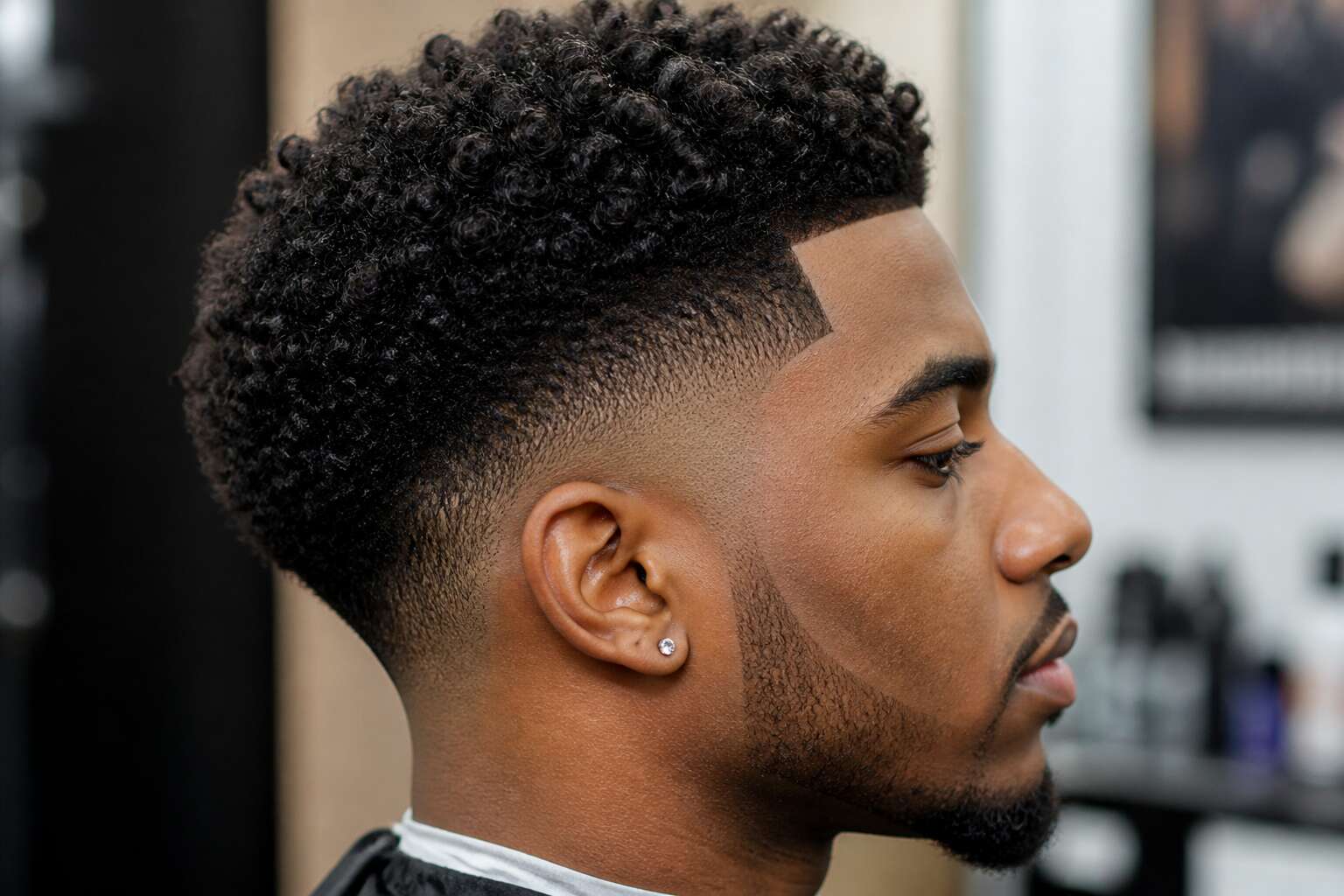
Styling Techniques for Defined Curls
Mastering the Leave-In Conditioner Method
The leave-in conditioner method demands respect. Cape Town’s humidity will wreck a curly hair low taper fade within an hour. Apply product to soaking wet strands. Your cuticles open, drink, and close. Skipping this step leaves you with a frizzy mess that has no sense of humour.
The reliable sequence looks like this:
- Rinse with cool water to seal porosity.
- Spread leave-in evenly with a wide tooth comb.
- Cup and press upward to form clumps.
Let those clumps air dry or diffuse on low heat. The result is defined coils around the taper, not frizzy disappointment. Use water first, then leave-in, then styling products. Your curls will thank you with actual shape.
Applying Curl Cream for Maximum Definition
The curl cream application is where intention meets texture. You sealed the cuticle with leave-in. Now you work with the hair’s memory. The cream anchors the coil structure that the taper reveals. Without it, the fade dissolves into undefined fluff.
Take less product than you think. I always warn against the squeeze. Rub between palms to activate the polymers. Press the cream into the hair using open palms. This motion determines whether a curly hair low taper fade holds its geometry or collapses. Work from nape to crown. The shortest hairs at the taper need minimal contact. The longer curls above drink more.
Apply in three passes:
- Praying hands over the top sections
- Finger comb through the mid lengths
- Pat gently over the tapered edges
Then stop! Overworking breaks the cast. Your hand is the final instrument.
Using a Diffuser to Enhance Natural Texture
Heat changes everything for a curly hair low taper fade. A diffuser does not simply dry, it fixes the shape the cream established. The warm air moves through each coil and sets the ring structure. The taper remains crisp because the shortest hairs dry first.
Work in sections. Lift the curl toward the scalp with the bowl and hold. No raking, no pulling. The motion stays deliberate. The cast hardens under the warmth and holds through the day. Do not rush this!
Balance the heat between roots and ends. The nape requires less exposure. The crown requires more. This difference separates definition from frizz.
- Dry the tapered edges on low heat
- Keep medium heat for the top curls
- Use a cool shot at the end to fix the cuticle
The diffuser gives a curly hair low taper fade its final form. Each section receives its own time, its own temperature, its own quiet attention.
Scrunching Techniques to Reduce Frizz
Scrunching defines the difference between a curly hair low taper fade that looks assembled and one that looks alive. The motion, a gentle palm press and release, encourages clumping without breaking the curl’s natural structure. Fingers disrupt. Palms persuade.
Approach the hair when it is damp, not dripping. Excess water dilutes the hold. For the top section of the curly hair low taper fade, cup the curl and press upward toward the scalp. Hold for two seconds. Release slowly. The shorter hairs at the taper edge need a lighter touch. They dry faster and become frizzy when handled aggressively. I have seen many clients undo their own work at this stage!
Use this sequence:
1. Begin at the nape, pressing upward
2. Move along each sideburn
3. End at the crown with a firmer press
The rhythm matters. Rushing creates broken coils. Patience creates definition. Each press sets the curl into its final resting position.
Refreshing Curls on Day Two and Beyond
By the second morning, the curly hair low taper fade has lost the initial hold from yesterday, but the pattern remains. The moisture has fled. South African humidity affects the shorter nape hairs first, leaving them dry. The crown retains its curl for a day longer than the edges.
Refreshing is a negotiation with the existing structure. I mist the hair lightly, but never to saturation. That is the trick! The goal is to revive the coils without inviting the frizz that follows a second soak. Overdoing it creates a sticky surface.
- The nape receives a quick, upward press.
- The sideburn area gets a gentle pinch.
- The crown is left untouched.
This restraint is the secret. By day three, the curly hair low taper fade relies entirely on the original definition, holding a structure that needs no reinforcement. The hands stay out of it, allowing the hair to breathe.
Maintenance and Growth Management
Establishing a Weekly Hydrating Routine
The weekly hydrating routine for a curly hair low taper fade is less about technique and more about rhythm. Every Sunday evening, I dedicate thirty minutes to deep moisture therapy, letting a masque of shea and argan oil absorb while the fade’s sharp edges rest.
This practice sustains the curl’s memory and keeps the transition zone from becoming brittle. I’ve learned to respect the porosity of each strand, adjusting the water temperature and the amount of leave-in according to Cape Town’s changing seasons. The scalp remains clear, the hair shaft stays supple, and the low taper fade retains its architecture without sacrificing softness.
- The masque’s dwell time matters more than its price.
- Weekly hydration reduces the need for daily styling.
- A consistent schedule prevents the curl from losing its spring.
Over months, this habitual care transforms maintenance into a steady practice. For anyone wearing a curly hair low taper fade, the hair grows at a more predictable pace, the fade’s lines stay honest, and every coil carries proper attention. My own curls have thrived under this system, proving that growth management begins with a single Sunday.
Choosing the Right Shampoo and Co-Wash Products
Most men overlook how much the wash step shapes a curly hair low taper fade. Shampoo and co-wash are not interchangeable. Shampoo removes residue from styling creams, while a co-wash preserves the moisture that keeps the fade’s edges pliable.
I choose products based on the season. Cape Town’s dry months call for co-washes with botanical extracts. Humid weeks warrant a gentle sulfate free cleanser.
- Clarifying shampoos for monthly deep cleaning
- Creamy co-washes for regular upkeep
The curly hair low taper fade rewards this deliberate approach. Hair grows at a steady pace, and the fade remains sharp without sacrificing the curl’s natural movement.
Trimming Schedules to Preserve the Fade Shape
A regular trim every four to six weeks preserves the architecture of a curly hair low taper fade. Curls spring back unevenly when left unchecked. I book my barber before the fade loses its gradient, not after. The neckline and temples need attention first, as those areas grow fastest.
For maintenance, I follow a simple rule: schedule cuts around your curl pattern’s shrinkage. This prevents the fade from being swallowed. The curly hair low taper fade works best with disciplined upkeep. Your barber should use scissors on dry curls, never clippers over the top. That keeps the shape defined without sacrificing the movement you worked to enhance.
Managing the Transition Phase Between Cuts
The awkward phase between cuts tests your patience more than your curl definition. When the curly hair low taper fade starts blurring at the edges, you face a choice. Hide under a beanie or manage the transition with intent. I choose intent, mostly because beanies ruin my parting.
I use strategic stretching. Let the top curl forward while training the sides with water and finger combing. This builds a deliberate frame around the fade instead of letting growth run wild.
Some methods that keep the shape honest:
- Comb only damp hair with a wide tooth comb.
- Shift your parting slightly to give the fade room to settle.
- Accept that week three differs from week one. That is by design.
The curly hair low taper fade evolves when you treat growth as part of the style. The barber’s work stays visible longer when you manage the shape instead of hiding it. Patience, applied daily, becomes the product.
Nighttime Routines to Protect Curl Pattern
Nighttime shapes how the curls behave tomorrow. The curly hair low taper fade relies on this quiet stretch of hours to keep its architecture. I wet the top section until the clumps reform, then press out excess water with a cotton t shirt.
The sides need nothing. They stay dry so the fade line remains sharp against the skin. I gather the top into a loose pineapple with a silk scrunchie, letting the front curls rest forward. A satin pillowcase reduces friction while I sleep. This is where the curly hair low taper fade separates from looser styles; the contrast between defined top and bare sides only works if both receive different overnight care.
Some evenings I add a few drops of jojoba oil to the ends. Most evenings I do not. The overnight reset gives the curl pattern a chance to settle. When morning comes, a short misting restores the shape without disturbing the fade.
Dealing with Common Curl Issues Like Shrinkage
Shrinkage distorts the curly hair low taper fade more than any other issue. A top that measured four inches stretched sits at two inches once dry. That changes how the fade reads! I track growth by stretched length only. The style demands this separation between curl length and actual progress. When the top grows, the sides need faster clipping to hold the taper line.
- Check shrinkage after a mist, not before
- Use a wide tooth comb on wet curls only
- Photograph the top every two weeks
The curly hair low taper fade survives shrinkage through patience. Styling for length means pulling the front forward, never upward. Growth management becomes regular trims and quiet waiting. Shrinkage never leaves, but it stops surprising you.
Face Shape Compatibility and Customization
Balancing Round Face Proportions
The barber’s chair holds a quiet truth: a round face craves verticality, and the curly hair low taper fade delivers it with precision. When the fade starts above the temple, the crown keeps its volume, which stretches the eye upward instead of sideways. This is not guesswork; it is geometry applied to hair!
For my clients with fuller cheeks, I adjust the taper’s angle by leaving more density at the top. The sides, meanwhile, are shorn close to the skin to minimise width. A clean, squared sideburn reinforces that vertical line.
Consider these adjustments for round proportions:
- Ask for a fade that sits higher on the temples.
- Keep the parting sharp to interrupt the face’s circle.
Used this way, the curly hair low taper fade becomes less of a haircut and more of a corrective measure!
Complementing Oval Face Structures
“A well-cut oval needs no tricks,” a Johannesburg barber once told me. The curly hair low taper fade agrees. For clients with oval face structures, the cut works through restraint. The low taper starts below the cheekbone, keeping the top’s curl volume intact without stretching the face. This balance is rare.
I customise by softening the transition line. An oval face can handle sharper edges, but a gentle blend feels more contemporary. Here is the checklist I use:
- Keep the fade low, around the mid-ear.
- Leave the crown fuller to echo the face’s symmetry.
- Frame the hairline with natural curls.
The curly hair low taper fade on an oval face is less about correction and more about synergy. It follows the head’s natural curves.
Structuring the Fade for Square Jawlines
A square jawline does not bend. It expects the cut to meet it head-on. The curly hair low taper fade answers without retreating. The fade drops low, hugging the ear lobe, leaving the side profile solid. This solidity mirrors the jaw’s geometry, preventing the fade from cutting too high and creating a hollow appearance.
- Drop the fade to the mid-ear lobe.
- Keep temple density to soften the hinge of the jaw.
- Cut sideburns straight across to anchor the facial line.
I structure the crown to shoot upward. The curl volume builds a vertical counterweight. The eye travels up, away from the sharp angles. This cut is a collaboration. The fade grounds the shape, the curls lift it. It is a balance of weight and air, tailored to the hardest facial framework.
Softening Angular Features for Heart-Shaped Faces
The heart shaped face presents a paradox. The brow demands width, yet the chin punishes it. I treat the curly hair low taper fade as a tool for equilibrium! The low fade slopes down to the ear, but I refuse to dig into the temple. Leaving curl density at the temple softens the sharp cheekbones. This density visually narrows the forehead. The chin, sharp as it is, will not fight the fade because the fade ends below the lobe.
- Keep the fade at the mid-ear lobe to preserve the jaw’s visual length.
- Leave curl weight near the temples to balance the wide forehead.
- Ask your barber to square the neckline, anchoring the narrow chin.
The crown should not spike upward. A softer, rounded top directs the eye downward, calming the pointed chin. The result is a curly hair low taper fade that stands as a quiet correction for a face that demands restraint.
Adjusting the Taper Height for Different Foreheads
No two foreheads are the same. The curly hair low taper fade adapts because the taper height can shift to suit the face. A high forehead needs the fade to start lower, hugging the ear, which shortens the visual span of the brow. A short forehead benefits from a slightly higher fade, which opens up the hairline and adds length.
For a prominent forehead, ask the barber to keep the top dense and the sides relaxed. For a narrower forehead, the opposite works.
- High forehead: lower taper start, keep curls longer on top.
- Short forehead: raise the taper slightly, trim temple curls.
This adjustment makes the curly hair low taper fade a versatile cut for any forehead shape.
Variations and Personalization Options
Combining with a Hard Part or Line-Up
The curly hair low taper fade has never been a static style. In a culture that prizes individuality, the barber’s chair becomes a place for negotiation. One of the most compelling adjustments is the integration of a crisp hard part. This line adds a geometric definition that contrasts beautifully with the rounded volume of curls, giving the face a sharper focal point. It acts as a visual anchor, directing the eye along the gradient of the fade with a sense of purpose.
For those who prefer a cleaner, more executed aesthetic, the line-up offers similar results. This technique uses a sharp razor to square off the edges, creating a stark delineation between the beard and the fade. When paired with the continuous curve of the textured hair, the effect is one of balanced tension.
The resulting style can change the wearer’s entire demeanor.
– A hard part leaning to the left can imply a structured, forward-moving personality.
– A central part can create a sense of symmetry that is rarely seen with natural curls.
– A high line-up can lengthen the neck, creating a more statuesque silhouette.
The barber must consider the direction of the curl pattern before carving these lines. A part drawn against the natural flow will force the hair to conform, altering the shape of the fade. This is the true art of personalization. It is not about the destination, but the subtle engineering of the path you take to get there.
Integrating a Skin Fade for a Sharper Contrast
Integrating a skin fade into the curly hair low taper fade is a deliberate escalation. The barber removes all guard length below the curve of the head, exposing the scalp in a clean arc. The curls above become heavier, more dominant. South African barbers have refined this transition, and the contrast is unmistakable.
The skin fade sharpens the entire cut. Errors in the blend become obvious within days, so precision is non-negotiable. Your curl pattern and growth rate determine how often you return to the chair, usually every two to three weeks.
- Tighter curls hold the shape longer, stretching the time between visits.
- Loose curls need a slightly higher fade point to keep proportions balanced.
- The nape and sideburns must be sculpted to follow the fade’s angle.
The texture of the hair carries the look. The shorter the fade, the more the curls command attention. For a curly hair low taper fade, this version turns the style into a statement.
Opting for a Textured Top with a Low Taper
A textured top changes the entire mood of the curly hair low taper fade. Instead of uniform curls, the barber cuts the crown with deliberate inconsistency, creating varied lengths that catch the light. This style suits men who want movement without losing the clean foundation. I always ask for a dry cut at this stage, because wet curls lie about their true length.
Personalization lives in the details. You can request a razor line behind the ear to match the taper angle, a slightly deeper fade in the temporal region to accent the texture, or leave a few longer strands at the front for a soft fringe.
In South African coastal humidity, this variation holds its definition because the texture gives shape instead of relying on perfect product placement.
Implementing a Burst Fade for a Unique Look
Implementing a burst fade for a unique look changes the game. Unlike the linear taper, the burst traces a semicircle around the ear, creating a halo of skin that makes your curls pop. In a curly hair low taper fade, this element adds a rebellious edge without sacrificing professional neatness. I once watched a Durban client request this variation, and the barber’s face lit up like a man who heard his favourite song.
Consider the details:
- Ask for a shallow burst to keep it subtle.
- Request a deeper arc for maximum drama.
- Pair it with a comb-over silhouette.
The curly hair low taper fade with a burst works wonders in humid Johannesburg afternoons. The contrast between skin and curl reduces the appearance of frizz, and that is a victory worth paying for.
Deciding Between a Curly Fringe or Comb-Over
Choosing between a curly fringe and a comb-over is a matter of daily temperament. The fringe leans into nonchalance, letting your curls fall forward with studied indifference. The comb-over, by contrast, declares intent. It sweeps the volume upward and back, showing off the clean lines of the curly hair low taper fade beneath.
In Durban’s humidity, the fringe can droop and cling. The comb-over holds its composure longer, especially when paired with a matte finish. Consider your morning routine before you commit:
- Fringe: five minutes of styling, zero fuss.
- Comb-over: requires a comb, a steady hand, and a touch of hubris.
The curly hair low taper fade accommodates both. The real question is whether you prefer to hide behind your curls or present the fade’s architecture without obstruction.
Exploring Color Placement to Enhance the Cut
Color placement changes how the eye reads a curly hair low taper fade. The fade’s architecture relies on a precise gradient of length, and pigment can either reinforce or blur that gradient. Lighter tones on the crown pull attention upward, making the taper feel steeper. Darker shades along the sides merge with the fade’s lower edge, giving the cut a heavier, more deliberate presence.
In South African sunlight, your chosen tones shift after weeks of exposure. Durban’s coastal salt air and the highveld’s harsh glare both affect colour chemistry. I prefer to treat colour as a structural decision, not a decorative one.
- Honey or copper panels through the fringe to sharpen the front profile.
- Shadow roots that keep the fade’s lower third clean and untouched.
- Babylights around the temples to echo the taper’s gradient.
Each option works within the curly hair low taper fade’s geometry, never against it.


0 Comments